

I bought the Garmin Striker 4 because I was tired of idling across a piece of Wilson Lake and guessing whether the marks under the boat were bass, bait, or a sunken limb. I am Clint Varner, 54, a retired electrical lineman outside Florence, Alabama. I fish Wilson and Pickwick most weekends and a few farm ponds during the week. My boat is a 17 foot aluminum jon with a 40 hp outboard and a bow mount trolling motor. I have been bass fishing for about 40 years. The Striker 4 caught my eye because it is small, it runs on battery power, and it comes with the transducer.
Here is the honest version. The Garmin Striker 4 is a 3.5 inch LCD fish finder with CHIRP sonar, Clear Vu scanning, a keyed interface with dedicated buttons, and a GPS waypoint map. It weighs 8 ounces and measures 3.6 by 1.6 by 5.9 inches. It has a 1 year limited warranty and a maximum measuring depth of 1600 feet. I fish 4 to 30 feet almost every trip. What matters is whether I can see a stump line, mark it, and find it again next Saturday. The Striker 4 does that. It also has a screen small enough that I squint in the afternoon sun, and a waypoint map that is not a full lake map. Both of those things are real. You should know them before you buy.
The Quick Verdict
A genuinely useful small boat fish finder for shallow bass water, as long as you accept the 3.5 inch screen and a basic waypoint map.
Amazon Check Today's Price →See the Garmin Striker 4 at Amazon
The same unit I run on the jon boat, with the included transducer, tilt and swivel mount, and power cable.
Amazon Check Today's Price on Amazon →How I've Used It
I mounted the Striker 4 beside the console on the jon boat using the included tilt and swivel mount. The power and data cable runs to the boat battery, and the transducer is on the transom. The first trip was a cool morning on Wilson. I spent the first hour not fishing. I idled a point with a brush pile, watched the bottom line, and marked the pile when I saw the shape I wanted. The buttons are the reason I did not throw the unit in the river. There is no touchscreen to fight with wet fingers. I can punch a waypoint with my thumb while the boat is moving.
The second trip was an 8 acre farm pond. I wanted to see if Clear Vu would help me find the edge of a weed line. It did. I could see the bottom change and the scattered cover, and I marked two spots where I had caught fish before but never knew exactly what was under me. Ruby, my 60 pound black Lab mix, rides along on calm mornings, and I keep her away from the treble hooks. The screen is small, so I sat close and used the dedicated buttons. That is how this unit wants to be used.
I have run it in 4 feet of water and in 30 feet. I have not run it in 1600 feet and I do not plan to. The 3.5 inch display is clear enough at idle and at trolling speed. At planing speed on a choppy day, I am not reading fine detail on a 3.5 inch screen, and you should not expect to. I use it to find cover, mark cover, and come back to cover. That is the job.
The 3.5 Inch Screen Is the Main Tradeoff
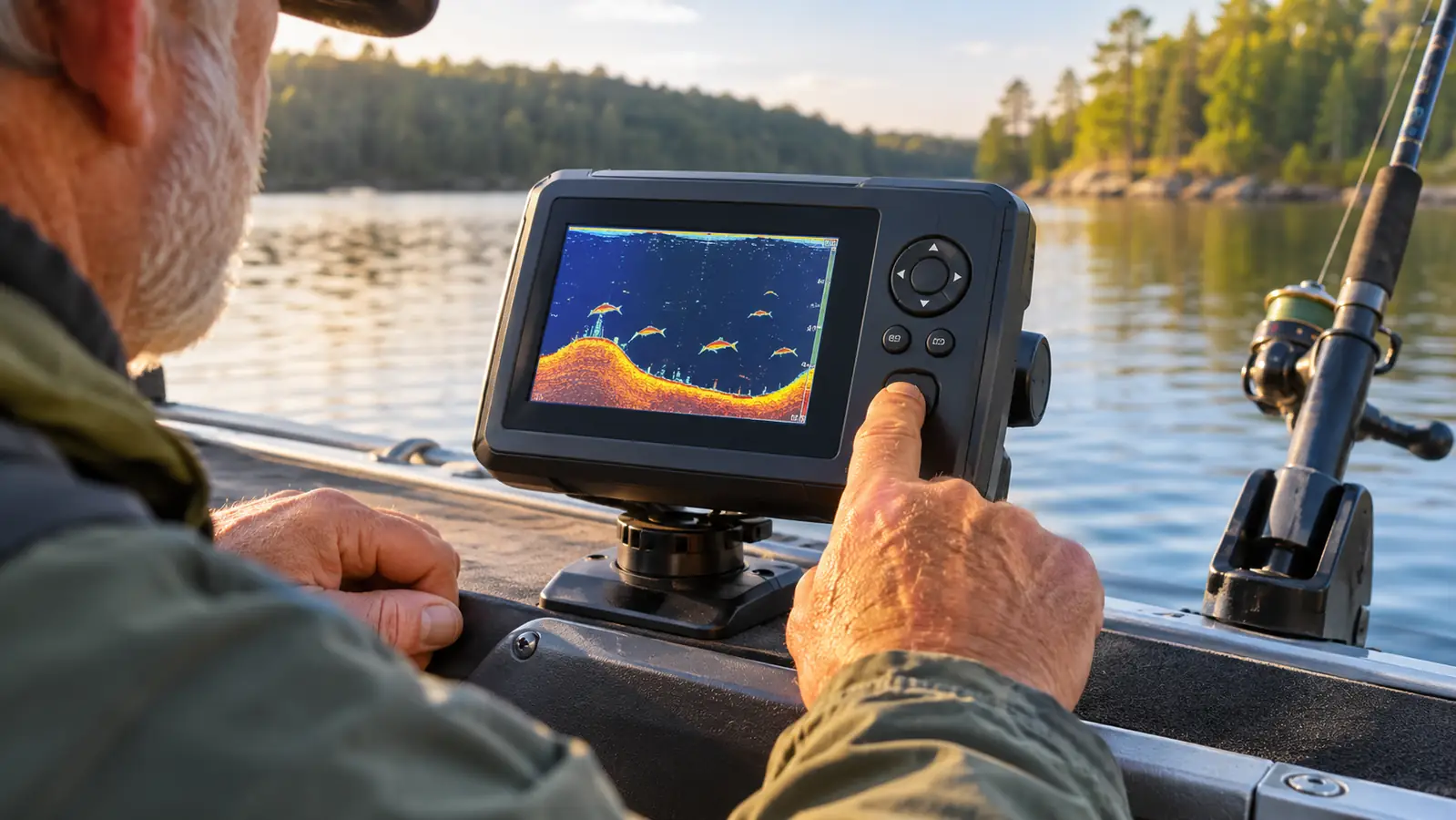
The display is 3.5 inches diagonal. The actual display area is 1.9 by 2.9 inches. In the garage, that sounds fine. On the water at 2 in the afternoon, with sun coming over your shoulder, it is the thing you notice first. I have shaded it with my hand more than once. I have also turned the boat so the console shadow falls across it. A bigger screen would be easier. A bigger screen would also cost more and take up more room on a 17 foot jon boat. That is the trade.
The LCD is readable, and the keyed interface is simple. I can go from the sonar view to the waypoint map without hunting through a menu. The buttons are labeled and they click. For a guy who does not want to read a manual on the water, that is worth more than a touchscreen. The flip side is that you are looking at a small window. At 54, I lean in. I mounted mine within arm's reach and slightly below eye level, which helps with glare and with my neck.
I would not buy this unit for a center console boat where the driver sits 4 feet from the screen. I would not buy it if I planned to run the boat at speed and read the bottom the whole time. I would buy it for a jon boat, a kayak, a small pond boat, or a rig where the screen is right in front of you. The size is the compromise. The payoff is a unit that fits on a small boat and does not dominate the console.
Clear Vu and CHIRP in Shallow Bass Water
Clear Vu scanning sonar is the feature I use most around shallow cover. It shows more of what is around the boat, and on a bass lake that means stumps, brush, and the edge of a creek channel. The CHIRP sonar gives me a clean bottom reading and a sense of how hard the bottom is. I am not a sonar engineer. I am a guy who wants to know whether the dark spot on the screen is a fish or a limb. The Striker 4 helps me tell the difference often enough to be useful. It is not a video game. It is a tool.
The waypoint map is the other half of that. I can mark a brush pile, a stump row, or the corner of a dock and come back to it. The GPS waypoint map shows the marks and lets me navigate to them. I have a few piles on Wilson that I have fished for years. Before this unit, I found them by lining up a white house on the bank and a certain pine tree. That works until the leaves come in or the light changes. A waypoint does not care about the leaves. I marked 11 spots on one Saturday and went back to 4 of them the next week.
The maximum measuring depth is 1600 feet. I have no use for that. If you fish deep reservoirs for suspended fish, the small screen and basic map will feel limited. For shallow bass water, the 1600 foot number is just a spec on the box. The real spec is whether the unit can hold bottom at 20 feet while the boat is moving. Mine does.
The Waypoint Map Does One Job Well
The waypoint map is not a chartplotter. It is a waypoint map. You mark locations, you name them if you want, and you navigate back. That is the job. If you expect contour lines for the whole lake, you will be disappointed. I did not expect that, so I was not. I use the map to get back to a brush pile and to keep my marks organized. If I catch a fish on a point, I mark it. If I catch nothing on a flat, I do not mark it. Over a season, the map becomes a record of what I found.
The map screen is small, so I do not try to read it at speed. I stop, look at the marks, pick the next one, and go. That is how I fish anyway. I am not running a tournament trail at 70 mph. I am a retired lineman with a 40 hp outboard and a thermos of coffee. The waypoint map fits that kind of fishing. It is also a good way to show a friend where the brush is without saying, go past the big pine and turn left at the white rock.
Installation Took Me Two Evenings
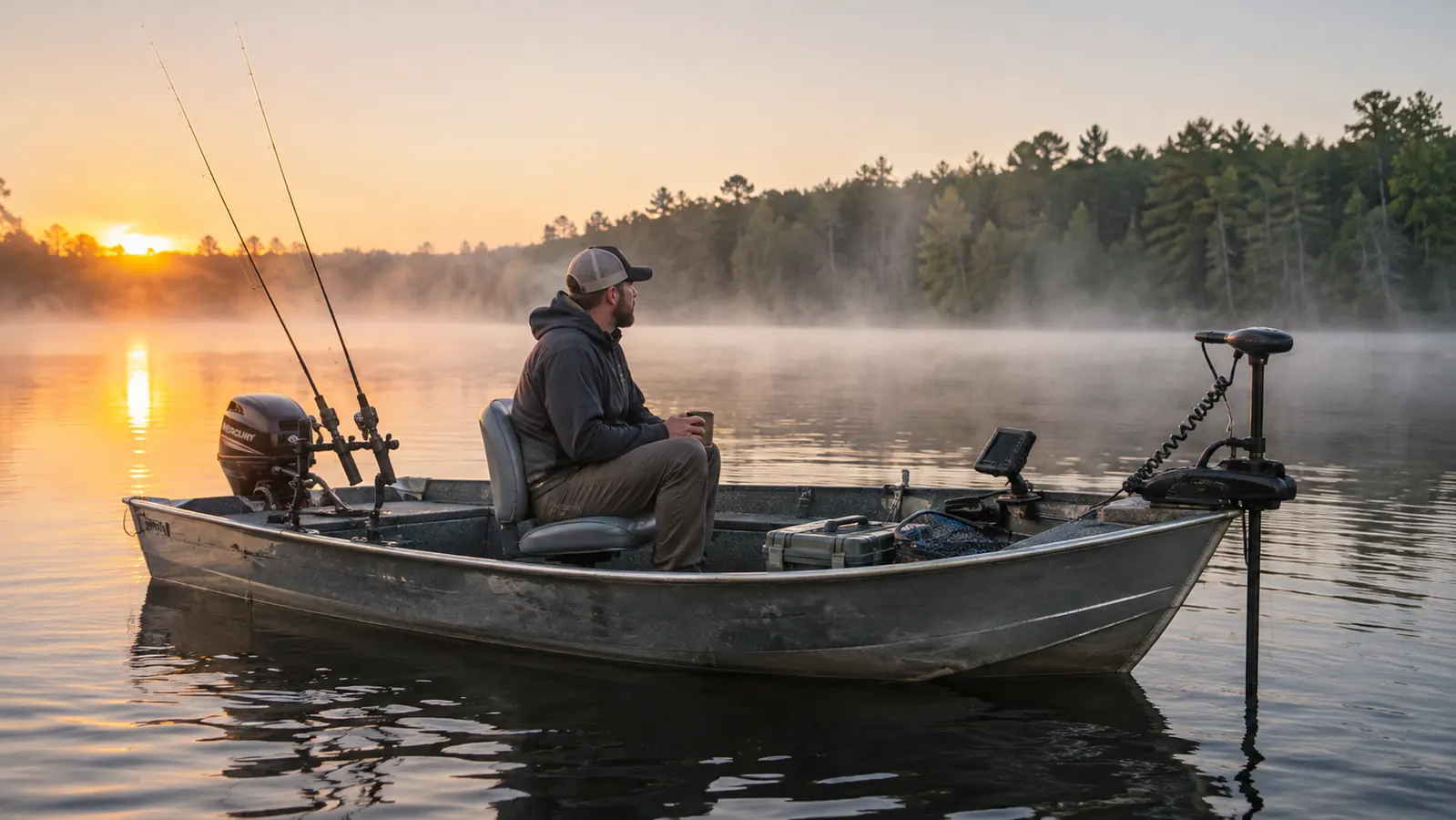
The box includes the Striker 4, the transducer, the tilt and swivel mount, and the power and data cable. I did the install in my garage over two evenings. The first evening was the mount and the cable. The second was the transducer. The mount is simple. The cable route took longer because I wanted it out of the way of my feet and the trolling motor. I used the included hardware and a few zip ties. I did not cut any holes I did not need.
The transducer is the part that decides whether the unit works at speed. I set it level with the bottom of the hull and slightly below, with the face aimed straight down. I took the boat to the river and ran it. It held bottom at idle and at a slow troll. At full speed on choppy water, I lost the bottom once. I moved the transducer up a hair and it got better. That is normal. Every aluminum boat is different. If you are not comfortable drilling into your transom, pay someone or use a bracket. The unit is only as good as the transducer signal.
The 8 ounce weight and the 3.6 by 1.6 by 5.9 inch size make it easy to mount in a tight space. I did not need a big flat panel. I did need to think about where my knee goes when I run the trolling motor. I ended up putting it on the starboard side of the console, angled toward me. The tilt and swivel mount lets me adjust it when the sun moves. That is a feature I use every trip.
Where It Frustrates Me
The screen size is the first frustration. I knew it when I bought it. I still feel it on bright days. The second is the waypoint map. It works, but it is plain. I would like more detail. I would like a bigger view. I would like to see the shape of a creek channel without guessing. That is not what this unit is. If those things matter more to you than the small footprint, spend more and get a bigger unit. I am not going to pretend the Striker 4 is something it is not.
The third frustration is the transducer install. It is not hard, but it is fiddly. You have to get the angle right. You have to route the cable so it does not get caught. You have to test it on the water, which means a trip that is half work and half fishing. I did that on a Tuesday evening when the wind was down. It was worth it. But if you want a unit that you pull out of the box and use perfectly in 10 minutes, this is not that. No fish finder is, but the Striker 4 makes you earn the good picture.
What I Liked
- Keyed interface with dedicated buttons is easy with wet or cold hands
- Clear Vu scanning is useful around shallow brush and stumps
- GPS waypoint map gets you back to marked cover
- Compact 8 ounce unit fits a small boat console
- Included transducer, tilt and swivel mount, and power cable get you on the water
- 1 year limited warranty
Where It Falls Short
- 3.5 inch display is hard to read in direct sun
- Waypoint map is basic and not a full lake chart
- Transducer install takes patience and a test run
- Small screen limits how far you can sit from the unit
The Striker 4 will not find fish for you. It will help you find the same brush pile twice, which is most of the battle on a river lake.
Who This Is For
This unit is for the bass angler in a jon boat, a kayak, or a small pond boat who wants simple sonar and a waypoint map without a big console. It is for the guy who fishes 4 to 30 feet, throws a jig or a Texas rig around brush, and wants to know what is under the boat. It is for the angler who does not want to spend a Saturday learning a menu system. The dedicated buttons and the small footprint are the reason to pick it. The CHIRP sonar and Clear Vu are enough to find cover. The GPS waypoint map is enough to get back to it.
It is also a good first fish finder. A friend who fishes with me sometimes had never used sonar. He picked up the buttons in about 5 minutes. That is not nothing. A lot of units in this size class make you cycle through menus to change a setting. This one has a key. If you are teaching a kid or a friend, that matters. If you are fishing alone and want to keep your eyes on the water, it matters more.
Who Should Skip It
Skip the Garmin Striker 4 if you need a large screen. If you run a bigger boat and sit several feet from the console, the 3.5 inch display will feel like a wristwatch. Skip it if you want full lake contour maps. The waypoint map is for marks, not for navigation across a strange lake. Skip it if you fish deep water for suspended fish and need fine detail at 40 or 50 feet. The unit can read depth to 1600 feet, but the screen and the map are not built for that kind of fishing.
Skip it if you hate installing things. The transducer is the difference between a good picture and a bad one. You will need to test it and adjust it. If that sounds like a chore, buy from a shop that will install it or pick a unit with a simpler mount. The Striker 4 is not hard, but it is not plug and play. I would rather tell you that now than have you cuss it on the ramp.
If you fish shallow cover, this is the Garmin I would put on the jon boat
The Striker 4 with the included transducer, 3.5 inch display, CHIRP sonar, Clear Vu, and waypoint map. It is small, it is simple, and it marks the brush you already know is there.
Amazon Check Today's Price on Amazon →