
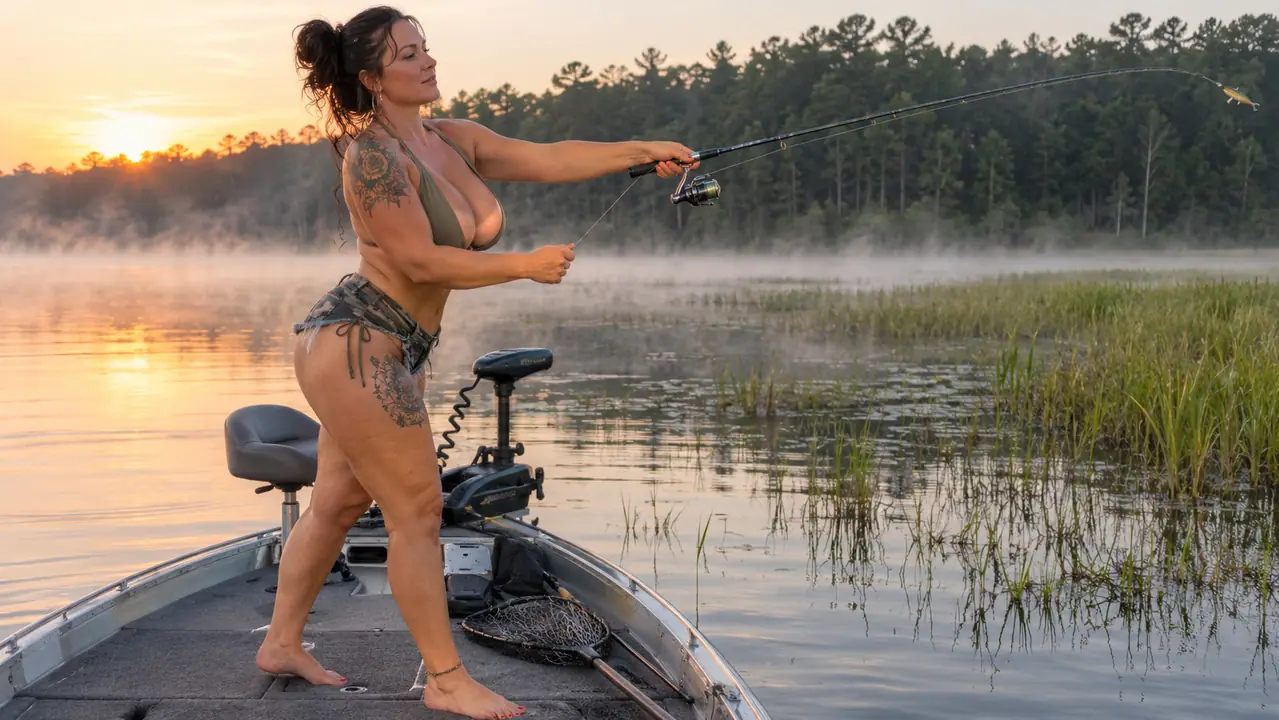
I bought my first pack of YUM Dingers because a fella at the ramp in Rogersville told me I was overthinking it. I had a boat box full of high-dollar baits and I was still getting skunked on Wilson in August. He reached in his shirt pocket, pulled out a plain soft plastic worm, and told me to fish it weightless around the grass. That was four years ago. Since then I have thrown a Yum Lures Dinger on more casts than any other bait I own, and I have also cussed them more than any other bait I own. Both of those things are true. That is what this review is about.
The name is a little goofy and the bait is about as plain as a lure gets. Five inches of soft plastic, one hook slot cut in the middle, no tail, no paddle, no rattles. Lay it on the deck next to a hundred other soft plastics and you would have a hard time picking it out. That is the point. There is nothing on it to spook a bass that has already been caught twice this month.
Here is the short version before I get in the weeds. The Dinger does the one thing that matters most in bass fishing. It falls slow and it looks alive while doing nothing at all. What nobody tells you is that the same softness that makes it fall right means you will go through them quicker than you expect, and that the hook slot is a genuine advantage only if you rig it the way it was cut to be rigged. Get those two things straight and this bait earns its space in the boat. Ignore them and you will blame a soft plastic worm for a problem that started in your own hands.
The Quick Verdict
Falls better than it has any right to, tears up faster than you want, and still earns a spot in the boat every single trip.
Amazon Check Today's Price →The bait I tie on when the bite goes dead
Five inches, one hundred to a box, and it rigs Texas, Carolina or wacky, weighted or not. It is the plainest thing in my boat and the one I trust most when nothing else is working. Check today's price and see what a hundred of them looks like.
Amazon Check Today's Price on Amazon →How I Actually Fish Them
Weightless Texas rig around grass is where most of my Dingers go. I use a 3/0 offset shank, skin hook the point so it rides weedless, and cast it up onto the flat where the grass starts to thin out. Then I do almost nothing. Two small twitches, let it fall, watch the line. On Wilson in late summer the bass sit under that grass and they will not chase a moving bait, but they will eat something that falls past their nose and quivers. The Dinger quivers better than most. That is not marketing. That is the shape of the plastic and how soft it is.
Wacky rig is the second way, and it is the one that surprises people. Hook it through the middle, no weight, let it fall on a slack line. It sinks with both ends fluttering up, and pressured fish in a farm pond will eat that when they will not touch a Texas rig. I keep a separate rod in the boat rigged wacky all spring, usually with a small O-ring so I am not running a hook through the middle of the bait every cast. Four or five fish per worm that way instead of one.
Carolina rig on the ledges at Pickwick is the third. A long leader, a light weight, drag it slow over shell beds in twenty feet of water. The Dinger rides up off the bottom and swims along behind the weight. It is not the flashiest bait for that job but it is the one that keeps catching when the shad-colored stuff quits. I have had mornings where a Carolina-rigged Yum Lures Dinger put eight keepers in the boat while my partner rotated through four swimbaits and caught two.
My setup is nothing special. A seven foot medium heavy casting rod, fifteen pound fluorocarbon, and the drag set tighter than most people would run it. The bait is light and it casts like a kite in the wind, so I keep the rod tip down and sidearm it under the limbs. On a spinning rod with eight pound line you can throw it farther but you will not have the backbone to pull a good fish out of the grass. I have tried both and I keep going back to the casting rod.
The Hook Slot Is the Whole Point
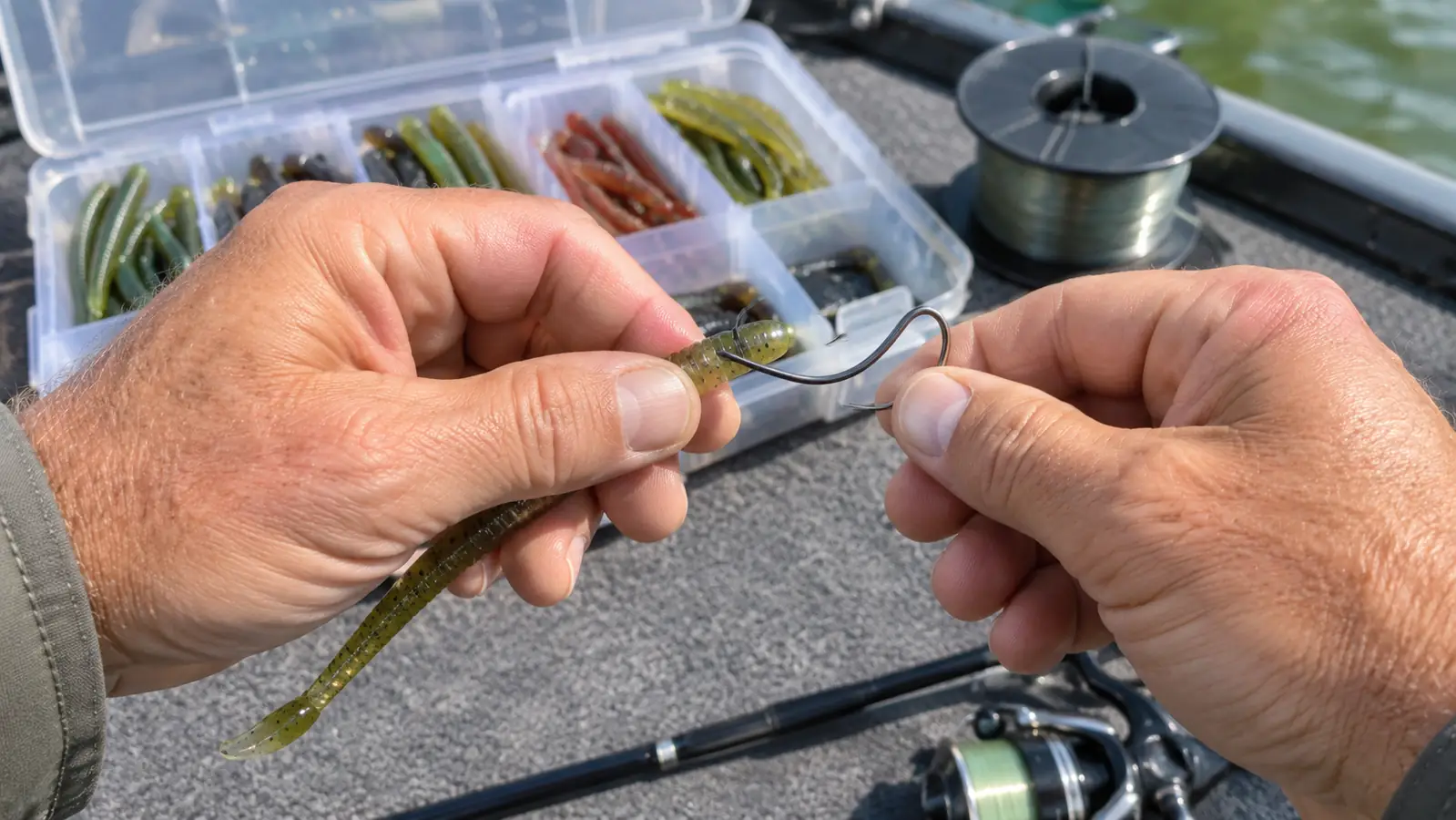
There is a slot cut into the body of this Yum Lures worm and it is the reason the bait works as well as it does. If you bury an offset hook down the middle of the plastic, the bait has somewhere to go when a fish bites down. The plastic slides along the shank instead of balling up in front of the hook point. That is what the listing means when it says better hook-ups, and after four years I believe it. My landing ratio on a Texas rigged Dinger is noticeably better than it is on stickbaits with no slot.
The catch is that the slot only helps if you line the hook up with it. I have watched people jam a hook in sideways, crossways through the body, and then complain the bait is not worth a flip. Rig it straight down the slot, bring the point out the top, then skin it back so it sits flush against the plastic. Do that and the bait is weedless and the hook is right there when a fish crushes it. Do it sloppy and you are fishing a worm that will not hook anything.
One more thing about the slot. It gives the plastic a place to fold, and that fold is what makes the bait work on a wacky rig too. Hook through the middle and the slot lets the worm hinge without tearing out at the hook entry. It is a small piece of design that most people never think about, and it is the difference between a bait that lasts four fish and a bait that lasts one.
I also think the slot helps on the hookset itself. The plastic collapses into itself instead of pushing the hook away from the fish's jaw. Whether that is the slot or just the softness I cannot prove, but I have landed enough fish on this bait with the hook barely through the lip to believe something is working right.
Durability, and What the Box Does Not Tell You
Now the part I wish someone had told me up front. These worms are soft. They are supposed to be soft, that is the whole reason they catch fish, but soft means they do not last. A good bass will tear the nose off a Dinger in one or two fish. Bluegill will nip the tail off in the shallows. Pulling one off a snag the wrong way will stretch it out until it is useless. I figure two to four fish per Yum Lures Dinger on a Texas rig, less in the spring when the fish are aggressive and eating the bait deep.
That is exactly why the hundred pack makes sense, and it is the only reason I buy them that way. If you are buying six or eight at a time you will run out on a good day and go back to throwing something you do not trust. A box of a hundred lives in the bottom of my boat through an entire season. That is not a complaint, it is the trade you are making. You are buying a bait that behaves right, not a bait that lasts forever.
The other durability note is heat. Leave a soft plastic in a dark tackle box in an Alabama truck cab in July and it will weld itself to the tray. I have ruined a handful that way and Darlene has heard about every one of them. Keep them in a bag, keep the bag out of direct sun, and they hold up fine from one trip to the next. That is not the bait's fault, but it is the kind of thing nobody mentions and everybody learns the hard way.
Where the Dinger Falls Short
It is not a big fish bait. I have caught plenty of three and four pound fish on a five inch Dinger and I have caught a few bigger, but if I am specifically hunting a kicker I am throwing something with more meat on it. The bait is subtle by design, and subtle does not always call in the biggest fish in the lake. Ruby has watched me lose enough of those to know the difference between a good fish and a big one.
It is also not a search bait. You cannot cover water with it. It is slow, it is small, and it is meant to be fished where you already believe a fish lives. If you are trying to find bass on a flat you have never looked at, a spinnerbait or a lipless crank will do that job in a tenth of the time. The Dinger is what you pick up after you have found them and they have gotten picky.
It fishes smaller than five inches in the water, too. Rigged weightless it has almost no profile, and in stained water after a rain it just disappears. I have thrown it on the Coffey Creek end of Wilson when the water was up and muddy and gotten nothing, then switched to something with a little thump and started catching. Clear water and pressured fish, that is this bait's lane. Muddy water is not.
And it is not a bait that rewards impatience. Most of the fish I catch on one bite it on the fall, before I have done anything at all. If you are the kind of angler who has to be moving the bait constantly, this worm will wear you out. It is a sit-and-wait bait in a sit-and-wait sport, and that suits me fine at fifty-four, but it does not suit everybody.
Rigging Notes I Learned the Hard Way
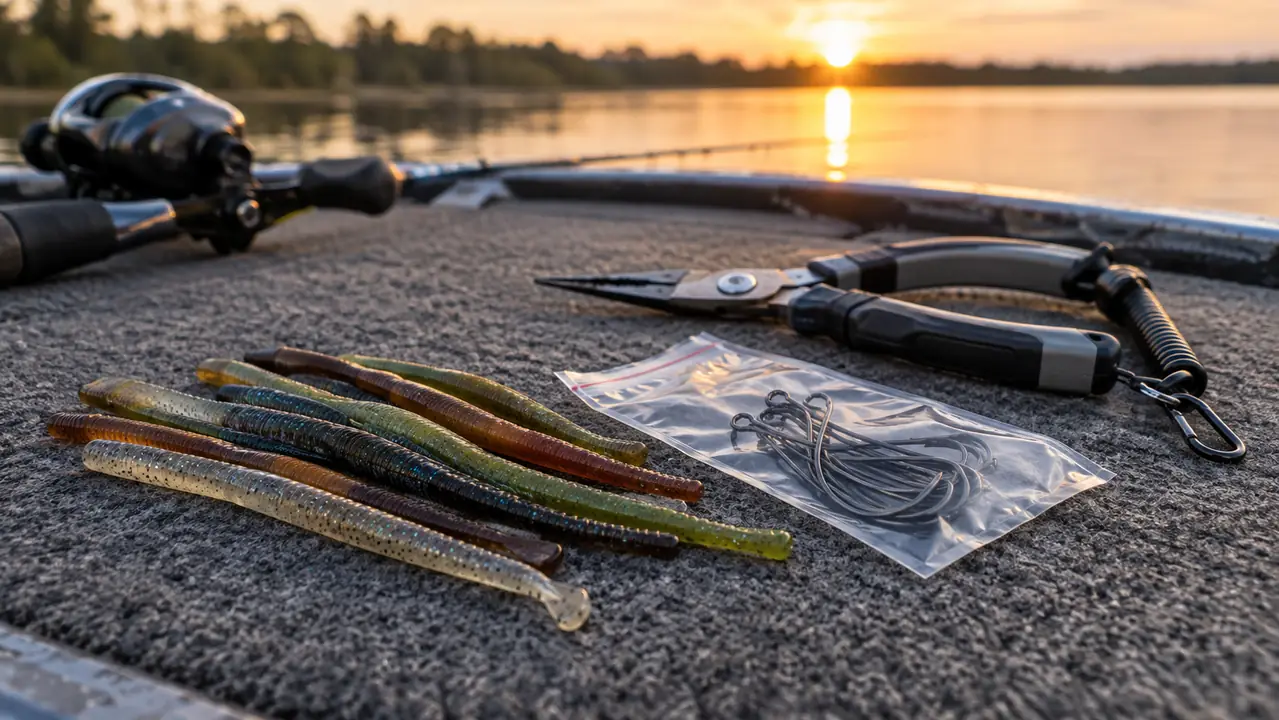
Use a hook that matches the bait, not the fish you hope to catch. A 3/0 offset is right for a five inch worm on a Texas rig. Go to a 5/0 and you will kill the fall and tear the bait in half on the hookset. Go too small and you will miss fish that eat it short. I keep a couple of packs of 3/0 in the boat and that covers almost every situation I fish on Wilson and Pickwick.
Skip the heavy weight when the fish are pressured. The reason this bait works on public water is that it falls slowly and looks like nothing in particular. Screw a quarter ounce of tungsten on the front and you have turned it into a rock. Let it fall on its own, watch the line, and set the hook when the line moves sideways. That sideways move is the whole tell, and if you are watching the bait instead of the line you will miss it.
Retie more than you think you need to. Soft plastic plus a hook slot means the bait slides up the line and the knot takes a beating all day. I check the last foot of line every dozen casts and cut back when it gets rough. Losing a good fish to a frayed knot on a bait you can afford to lose is a dumb way to end a morning, and I have done it more than once.
What Four Years Has Taught Me
Four years in and I still have not found a better bait for a pond that gets fished every weekend. I have tried the higher priced stickbaits and they catch fish too, but they do not catch more fish, and I do not grieve when I lose one of these in a tree. That is worth something when you fish as much bank as I do.
What I have learned is that the bait is only half of it. The other half is slowing down enough to let it work. The days I catch good on a Dinger are the days I make myself leave it alone on the fall and watch the line instead of the bait. The days I do not, I catch nothing and blame the worm. It took me about two seasons to figure out which one of those was the problem.
The other thing I learned is that a Yum Lures Dinger is a bait you buy in bulk and stop thinking about. When I was buying small packs I was hoarding them, fishing the same chewed up worm until it would not stay on the hook, and losing fish because of it. Now the box sits in the boat, I rig a fresh one when the old one gets ragged, and my hook-up rate went up for reasons that had nothing to do with the bait at all.
What I Liked
- Falls slow and looks alive with almost no input from you
- Hook slot genuinely improves hook-ups when you rig it straight down the middle
- Rigs Texas, Carolina and wacky, weighted or weightless
- One box of a hundred covers a full season in the boat
- Catches pressured fish in clear farm ponds where moving baits get ignored
Where It Falls Short
- Tears up fast, two to four fish per worm on a Texas rig
- Soft plastic will weld to a hot tackle box if you leave it in the sun
- Not a search bait, you cannot cover water with it
- Small profile will not call in the biggest fish in the lake
I have had mornings where a Carolina-rigged Yum Lures Dinger put eight keepers in the boat while my partner rotated through four swimbaits and caught two.
Who This Is For
This is for the angler who fishes the same water over and over and needs a bait that works on fish that have seen everything. Bank fishermen on farm ponds, kayak guys on the creek, boat guys on pressured public lakes. If you throw slow plastics at all, a box of Yum Lures Dingers belongs in the rotation. It is also a good bait for somebody learning soft plastics, because it forgives a bad retrieve. You can do almost nothing with it and still get bit.
Who Should Skip It
Skip it if you are a power fisherman. If your day is built around covering water with moving baits, this worm will sit in the box untouched. Skip it if you cannot stand losing baits, because you will lose them, to fish and to snags both. And skip the hundred pack if you only fish a couple of times a year, since soft plastic does not improve with age in a hot garage. Buy a small pack, fish it, and see if the fall suits you before you commit to the whole box.
A hundred worms and a season of slow falling
It is not fancy and it will not last forever. It is the bait I tie on when the fish quit chasing and I still want to catch something before the sun gets high. Check today's price and see if the pack math works for how you fish.
Amazon Check Today's Price on Amazon →