
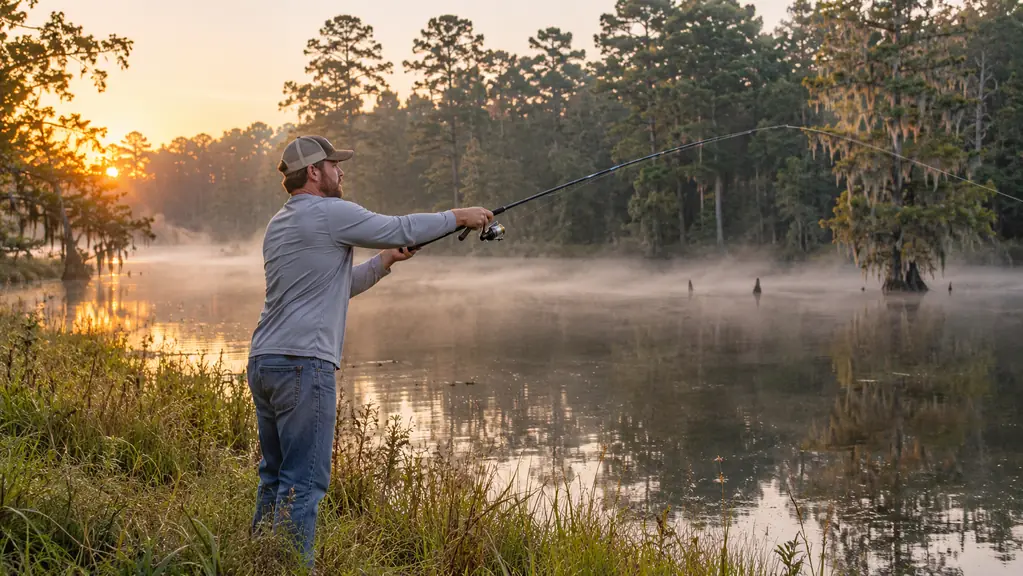
The first bass I caught on a YUM Dinger was not a memorable fish. Maybe a pound and a half, sitting on a point of hydrilla in a farm pond over near Lexington, in water shallow enough that my trolling motor was throwing mud. I had thrown a crankbait for forty five minutes without a tap. I tied on a five inch Dinger, Texas rigged, no weight at all, and the fish ate it on the second cast. That was early March. I have had a Dinger tied on for some part of nearly every trip since.
A hundred pack of five inch worms sounds like more than one man can fish. It isn't, if you fish the way I do, and it also isn't so many that you quit paying attention to how they wear. Yum Lures has been building the Dinger for a long while and it is one of the few soft plastics I buy by the bag instead of by the pack. What follows is an honest accounting of a full season on Wilson, Pickwick and three farm ponds, including the parts I don't love.
The Quick Verdict
A subtle, do-almost-anything worm that gets bit on flat, sunny, crowded water when the flashy stuff gets ignored. Buy the bag, not the pack.
Amazon Check Today's Price →The Only Soft Plastic I Buy By the Hundred
Five inches, a hook slot that actually lines up, and enough quiet action to get bit on water that has seen every bait in the lake. This is the bag that lives in my front compartment from March through October.
Amazon Check Today's Price on Amazon →How I've Used It
I run a 17 foot aluminum jon boat with a 40 horse outboard and a bow mount trolling motor, and it is not a fancy rig. Most of my spring and early summer goes to Wilson and Pickwick, working main lake points, creek mouths and the grass that shows up in the backs of pockets once the water warms. The rest goes to farm ponds where the bank is the only access and the fish see maybe four baits a year. That mix matters for a review, because a bait that shines on unpressured pond fish and falls apart on a Saturday lake is not the same bait at all.
My season with the Dinger started in late February, water in the low fifties, and ran into early October, water still pushing eighty. That is a wide window. In the cold I fished it slow and weightless, letting it fall and sit. In the heat I skipped it under docks and let it shimmy down through the shade. I probably went through fifty or sixty baits across those months, some lost to fish, some to snags, some torn past the point of staying on the hook. The trip that sold me came on the ninth of March, a Saturday, air around fifty with a north wind pushing down a pocket on the north end of Wilson. I had worked a jerkbait and a lipless crank through that same water without a follow. I picked up the spinning rod with a weightless Dinger, made four casts to a laydown, and on the fifth the line just got heavy. Two pounds eleven ounces on the hand scale. I caught three more off that same piece of wood before the wind quit.
Ruby rides with me on calm mornings, six years old now and about sixty pounds, and she has learned to sit still when I set the hook. She has not learned to stay out of the treble hooks, so I keep the open box on the far side of the deck from her. Darlene does not fish and does not understand why the garage smells like soft plastic, but she has stopped asking, which I count as support.
The Hook Slot Is the Reason I Buy These Twice
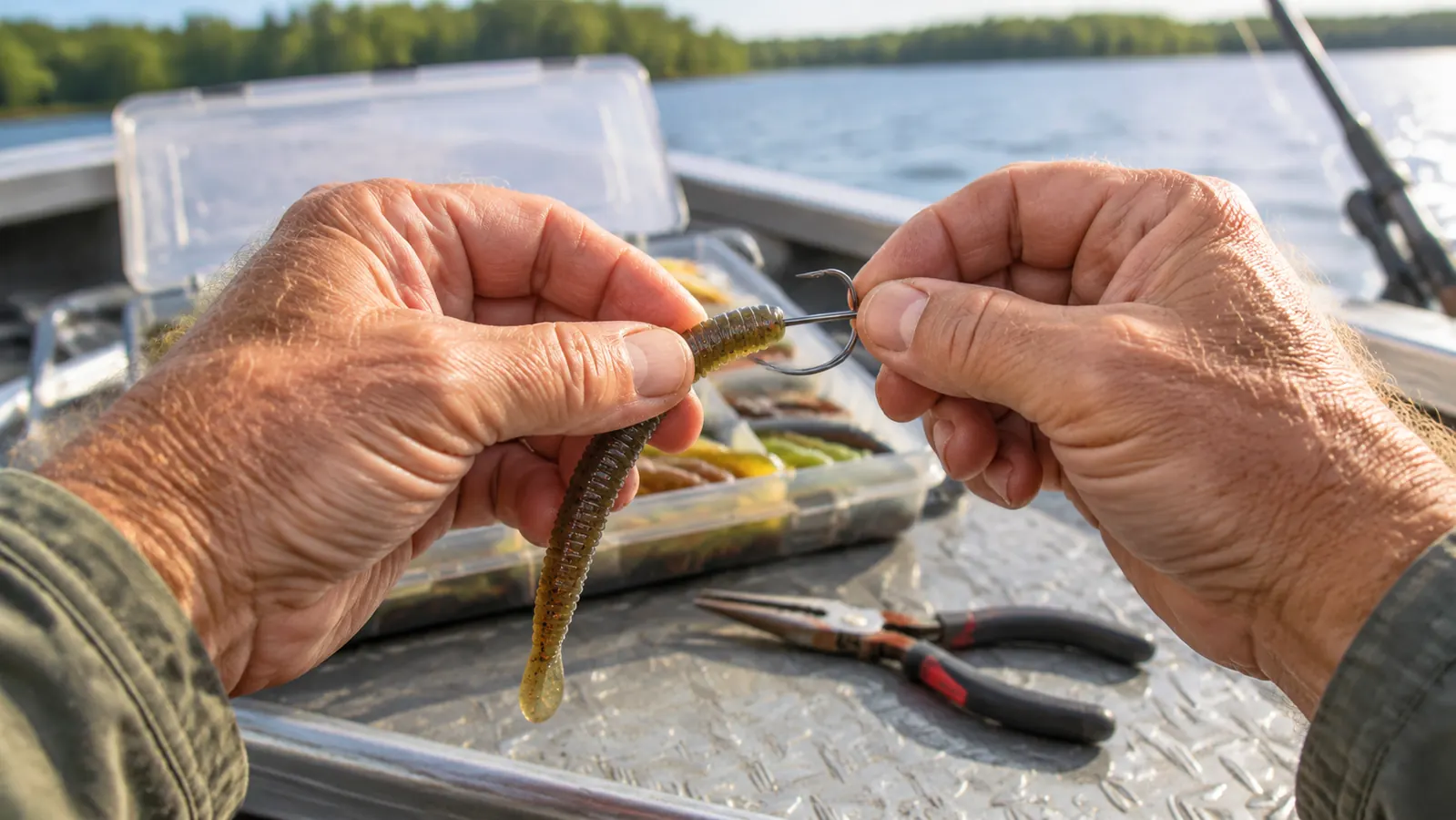
Most stick style worms make you guess where the hook should go. The Dinger has a slot molded down the back, and once you get in the habit of laying the hook point into it, your rigging gets faster and your hookups get better. The bait slides up the line on the hookset instead of balling up in front of the hook eye. On a Texas rig that is the difference between a fish and a shrug, especially with a light wire hook and a soft rod tip.
The plastic itself is soft, softer than a lot of the poured worms I used to buy, and that softness is where the action comes from. It quivers on the fall with almost no input from you. It also means the bait does not last forever. I average somewhere around two to four fish per worm on a good day, fewer if the fish are short striking or if I am fishing around rock.
I keep a paper log of every trip, mostly a habit left over from thirty years of keeping a work log for the utility, and the numbers from this season are the part I trust most. On Texas rigs with the hook laid into the slot I landed roughly seven of every ten fish that ate. The season before, fishing a stick worm with no slot and burying the hook point by eye, I was closer to five of ten. Same rod, same line, same hook brand. Some of that is me getting better at waiting a half second before I swing, but not all of it.
I started carrying a bottle of super glue in the boat this season and gluing the head of the worm to the hook eye on my Texas rigs. That one habit probably doubled the life of each bait and cut my re-rigging time in half. If you buy a hundred of these, buy a two pack of glue with them. It is not a knock on Yum Lures, it is just what soft plastic does.
Rigging: Four Ways I Fish It
Weightless Texas is my default and the way I would tell anyone to start. A 3/0 or 4/0 offset hook, no weight, thrown at shallow cover and let fall on a semi tight line. The bait sinks slow and level, which is exactly what a bass sitting in six inches of water wants to look at. This is the rig that carried most of my spring. I fished it around buck brush, flooded willows and the edges of grass beds, and I caught fish on it when the water was still cold enough that I had on two jackets. There is a pond up the road from me, maybe eight acres, with a gravel strip on the dam end and an old fence line running down the middle under the water. In late April I stood on that dam in a light rain and caught nine bass in about two hours, all of them on a weightless Dinger, and the biggest was right at three pounds. I never moved twenty yards.
Weighted Texas comes out when the wind picks up or when I need to get down a ledge in fifteen to twenty feet. A 1/8 or 3/16 bullet weight is plenty. The Dinger takes a pegged weight well because the plastic is dense enough to hold it in place on the cast but still collapses when a fish crushes it. Carolina rig is the summertime version, a three quarter ounce weight, a two foot leader, dragged across main lake points on Pickwick. That is not a glamorous way to fish. It is, however, how I put eleven fish in the boat one July morning off a single point.
Wacky rig is the fourth and the one that saved several trips. Hook through the middle of the bait, no weight, thrown at dock posts and flooded timber. The Dinger has enough body to hold a wacky hook without folding over, and it shimmies on the fall in a way that gets a reaction from fish that have quit eating. I do not bother with an O-ring. I lose a few baits that way and I am fine with it.
How the Plastic Holds Up
Here is the honest part. This is not a durable bait in the way a hard plastic or a hand pour is durable. It is a soft bait built to move, and soft baits tear. The tail section is the first thing to go, usually after a fish or two grabs it and shakes. A torn tail still catches fish, it just loses some of the wiggle, so I fish it until the hook slot gives out rather than until it looks pretty.
Heat is the other thing to watch. A bag of soft plastic left on the front deck in July sun will weld itself into one lump, and no amount of peeling gets it back. I keep mine in a soft bag in the console or under the seat now, out of direct sun. Same goes for mixing them loose in a box with other plastics. Keep the Dinger in its own bag and it will stay usable. I learned that the careless way last August, when I set a fresh bag on the deck while I ran up to the house for lunch. By the time I came back the worms had fused into a single block the shape of the bag. Fifty some odd baits, gone for an hour of not thinking.
The 100 pack format is the reason this review reads the way it does. When you are buying a bag that big, you stop babying individual baits. You cut a torn one off and tie on a new one without thinking about it, which is exactly how soft plastic fishing should work. It changes your behavior more than it changes the bait.
Where the Dinger Falls Short
It is a slow bait. If you are trying to cover water, find fish, and cover three miles of bank before the sun gets high, a Dinger is the wrong tool. It is a bait you fish, not a bait you cast and reel. On a day when I need to locate fish, I throw a moving bait first and come back with the Dinger once I have a target. Anybody who tells you this is a search bait is selling something. I got stubborn about it in June, on Pickwick, and spent the first two hours of a morning throwing a Dinger at empty water off a long clay point. Switched to a crankbait, found fish in twenty minutes, then went back over them and caught four on the Dinger. Two hours I will not get back.
It also catches numbers more than it catches giants. My biggest fish of the season came on a jig, and most of what I caught on the Dinger were in the one to three pound range, with a handful better than that. On Pickwick in April I had one fish that would have gone five plus, and she came unpinned at the boat because I was fishing a light hook and a soft rod. That was my fault, not the worm's, but it is worth saying that this is not the bait I reach for when I am hunting a kicker.
The last limitation is the obvious one. It is a soft plastic. Weedless does not mean snag proof. I lost a good number of these in rock and brush, and every one of those is a bait you paid for and a fish you did not catch. That is the deal with this whole category and not something Yum Lures invented.
What I Liked
- Hook slot makes rigging faster and improves hookups on a Texas rig
- Soft enough to quiver on the fall with almost no rod input
- Fishes four ways: Texas, Carolina, wacky, weighted or weightless
- Catches pressured fish on bright, flat, crowded water
- Buying by the hundred changes how you fish, in a good way
Where It Falls Short
- Soft plastic tears after a few fish, tail goes first
- Melts into a lump if left in the sun on the deck
- Not a search bait, it is slow by design
- Catches numbers more than it catches big fish
Eleven bass in three hours off one point on Pickwick in July, dragging a Carolina rigged five inch Dinger through the same stretch of rock I had already fished with two other baits that morning.
Who This Is For
This is for the angler who fishes pressured water and is tired of throwing baits that look better than they fish. If your lake gets hammered every weekend, if the fish have seen a thousand chartreuse crankbaits, a quiet little worm that falls slow and does not do much is often the only thing that gets a reaction. It is also for the bank fisherman, because a weightless Texas rigged Dinger is about as snag resistant and as castable as anything you can throw from the shore.
It suits the guy who wants one bag in the boat that covers a lot of situations. Five inch, one bag, four rigs, fishes from February through October. If you are the sort who carries twelve boxes and switches baits every ten casts, you already know whether you want these. If you are trying to simplify, this is a good place to do it.
Who Should Skip It
Skip it if you are a power fisherman. If your day is built around covering water with moving baits and you want a soft plastic only for flipping heavy cover, a five inch stick worm is not that bait. Skip it if you cannot keep soft plastic out of the sun, because you will ruin half a bag and blame the bait. And skip it if you want a bait that lasts a dozen fish, because this one will not, and that is not a defect, it is what soft plastic is.
One Bag, Four Rigs, February Through October
Five inch Dingers, a hook slot that lines up, and enough subtle action to get bit on water that has been fished hard all weekend. It is the soft plastic I restock without thinking about it.
Amazon Check Today's Price on Amazon →