
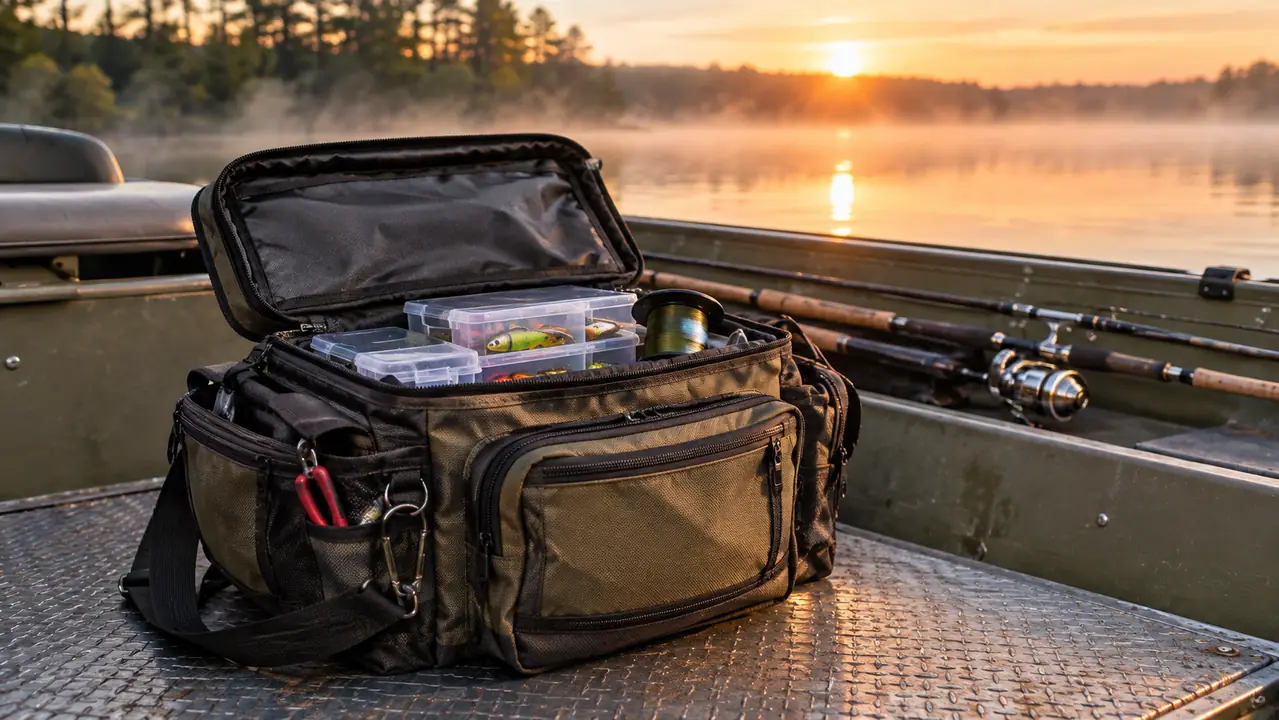
I have had the KastKing KarryAll on my boat since early March. A buddy lent me his Plano Guide Series for three weeks in April so I could run both bags out of the same 17-foot aluminum boat, on the same water, with the same six trays of jerkbaits, jigs and shaky heads. Wilson and Pickwick mostly, with one farm pond trip thrown in. Same guy fishing, two bags, which is the only way I know to tell the difference between a bag that works and a bag that just photographs well.
Here is the short answer. If you fish out of a small boat and you move two dozen times in a morning, the KastKing KarryAll is the bag I would spend my own money on again. It is 20 liters, it weighs 0.85 kg empty, and it measures 13 by 11 by 11 inches, which is the difference between a bag that rides beside the console and a bag that lives on the bench seat behind you. If what you want is a bag that stands up on its own under a deck and swallows every tray in your garage, the Guide Series does that job better. Everything after this is the detail behind those two sentences.
| KastKing KarryAll | Plano Guide Series | |
|---|---|---|
| Tray capacity | Five 3600 trays in the main compartment, flat or on edge, up to six boxes total with terminal tackle | Built around Plano's own trays, so the bag and the boxes come from one company |
| Water resistance | 600D Oxford shell listed as water resistant; sheds spray and a passing shower | Guide Series fabric is water resistant too; neither bag is a dry bag |
| Structure when loaded | Soft shell, so it slumps when it is only half full | Holds a boxy shape better when packed light |
| Small-item organization | Three zippered compartments plus a utility pocket | More outside pockets for tools, line and a scale |
| Deck footprint | 13 x 11 x 11 inches, slips between the console and the rod locker | Bulkier footprint that wants its own real estate |
| Empty weight | 0.85 kg | Heavier empty, and you feel it on the walk in to a pond |
| Getting to a bait | Full zip main lid, so you reach the tray you want without unpacking | Top access gets tight once the bag is packed full |
| Trays in the box | Bag only, boxes sold separately | Some Guide Series kits ship with trays, so read the listing before you compare |
Where the KastKing KarryAll Wins
The footprint is what I noticed first. At 13 inches long, 11 wide and 11 tall, the KarryAll slides in between the console and the rod locker on my boat and stays there all morning. I do not have to move it to get to the trolling motor. I do not have to step over it. In a 17-foot aluminum boat, eleven inches of clear deck is not a small number. It is a place to put your foot when a fish boils under the boat and you need to get to the net without going swimming.
Empty, it weighs 0.85 kg. Loaded with five 3600 trays it is still light enough to pick up one-handed and swing from the truck bed to the ramp. The web handle on top is where my hand goes every time, and the shoulder strap is what I use when I am walking a pond bank or crossing a parking lot at the ramp. I have carried it both ways and neither one made me regret the walk.
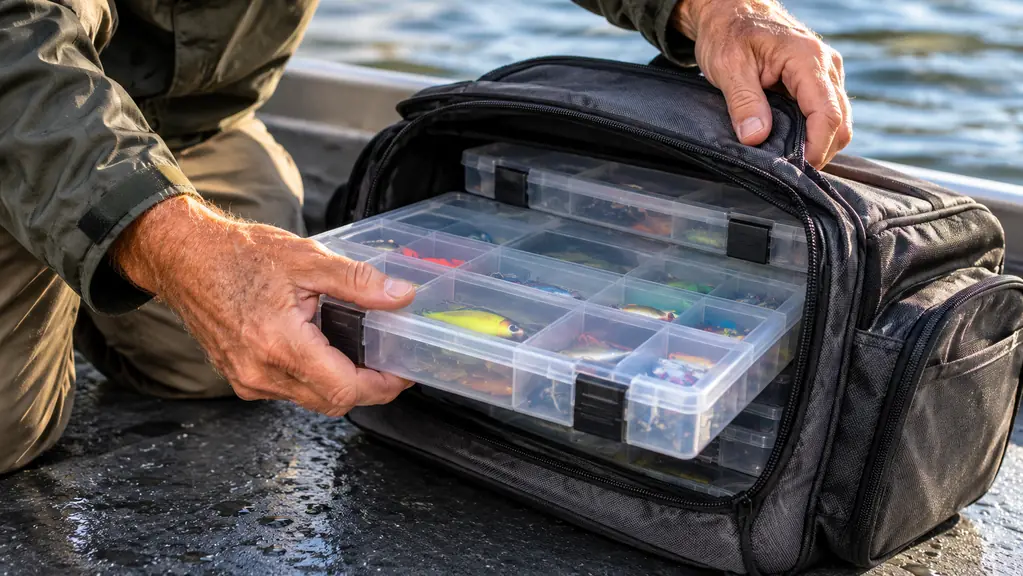
The layout is honest, which is a strange thing to say about a bag, but there it is. Five 3600 trays fit in the main compartment lying flat or standing on edge, whichever suits your baits. Once you use the upper zipper section for terminal tackle you can get up to six boxes into the bag. That upper section is where my hooks, weights and swivels live now. So when I stop on a point I open one lid, take a tray, and I am fishing. No digging through three boxes for a 3/0 hook while the boat drifts into the rocks.
The shell is 600D Oxford, listed as water resistant, and all three zippered compartments close with a zipper rather than a flap and a prayer. I got caught in a real rain on Wilson in late April, the sideways kind that runs twenty minutes and then quits like it was never there. Five trays came out dry. I would not leave it in the floor of the boat through a storm, because water resistant is not waterproof, but for spray, a wet deck and one honest shower, it did what it was supposed to do.
Where the Plano Guide Series Wins
The Guide Series holds its shape. That sounds like a small thing until you have watched a soft bag fold in on itself at the bottom of a locker. The Plano stays boxy even when it is half packed. It slides out from under a deck the same way it slid in, and it stands there on the floor while I reach in with one hand and keep the other on the rod. On a light day, one rod, four trays, a bottle of water and a sandwich, the Plano is the bag I would rather have with me.
Organization is the other place it earns its keep. There are more small outside pockets on the Guide Series, and that matters to a guy who carries a scale, clippers, a spare spool, sunscreen and a phone. My KarryAll has three zippered compartments and a utility pocket. I found a home for everything, but it took two or three trips to sort out where things belonged. The Plano told me where things went on the first morning.
Then there is the tray question. If you already own a stack of Plano trays, the Guide Series is the same family. No second set of boxes, no moving baits from one tray to another because the new bag is half an inch off. Some Guide Series kits ship with trays included, so read the listing carefully before you compare them bag against bag, because that changes the math.
The sideways rain on Wilson lasted about twenty minutes. Five trays came out of the KastKing KarryAll dry. That is the whole test, and it passed.
The bag that fits beside the console instead of behind you
Twenty liters, three zippered compartments, five 3600 trays in the main compartment. The KastKing KarryAll is the one that never came out of my boat.
Amazon Check Today's Price on Amazon →Three Weeks on the Water, Not a Spec Sheet
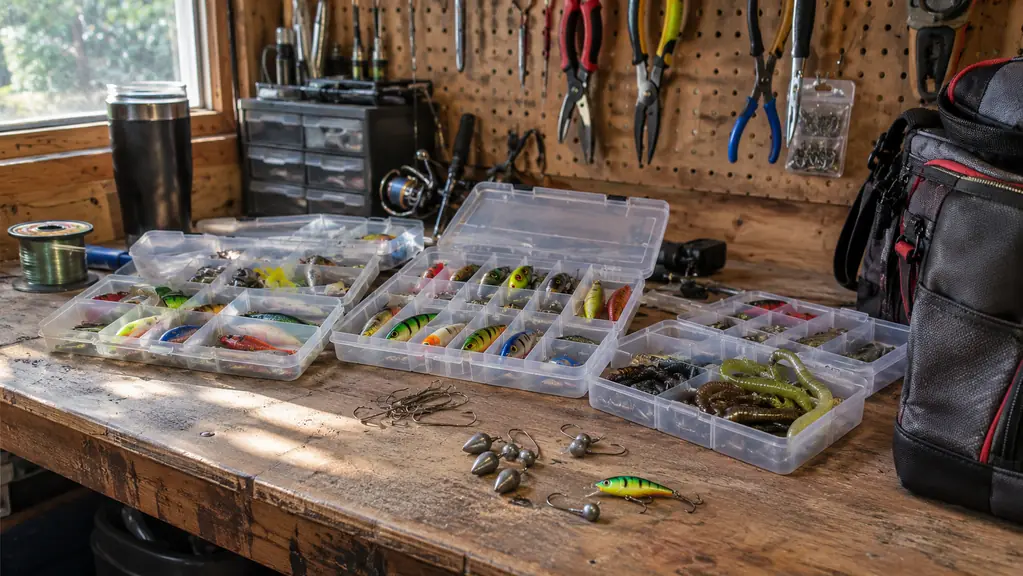
Packing in my garage is where both bags show their personality. Darlene will tell you the garage holds more tackle than the boat, and she is not wrong. My bench carries six open trays at any given time: one for jigs, one for shaky heads, one for jerkbaits, one for topwater, one for hooks and weights, and one that is a mess of everything. The KarryAll takes five of those in the main compartment and the sixth gets broken down into the upper section. The Plano took the same five and left less room for the odds and ends.
On the water the difference shows up on the move. I fish a trolling motor, stay in one spot for eight or ten casts, then go. Opening a full zip lid and pulling the tray I want while the boat drifts is a two-second job with the KarryAll. The Plano needs a little more room to open when it is packed full, and I found myself setting it on the bench seat rather than the deck so the lid had somewhere to go. That is not a knock on the bag so much as a fact about a small boat. A bigger rig makes the whole thing disappear.
Ruby rides with me on calm mornings, and a sixty pound Lab mix does not care where your treble hooks are. She has stepped on both bags. The Plano, being stiff, did not swallow her foot, which I appreciated more than I expected to. The KarryAll gave under her weight, the trays inside shifted, and I spent a minute sorting hooks that had slid into the wrong slots. Neither bag is a hook-proof barrier. If your dog rides along, keep the lid zipped and the bag on the far side of the console.
One more thing worth saying out loud. The KarryAll has no wheels and I do not miss them. Neither bag needs them. Anyone who has dragged a wheeled tackle bag across a gravel ramp one time will understand why I count that as a feature and not something missing.
The Small Stuff That Decides It
The zippers on the KarryAll are plain nylon coil, not sealed waterproof ones, and after three months of opening and closing them with wet hands they still run clean. The full zip main lid is the part I would fight to keep. It opens wide enough that I can see every tray at once and closes with one pull. The Plano's top access is handier when the bag lives in a locker, and tighter when the bag is packed to the lid. Neither design is wrong. They are built for different mornings.
The web handle on the KarryAll is stitched flat across the top, so the bag hangs level when I pick it up one-handed. The shoulder strap is padded and it adjusts. I carried it a quarter mile down a bank trail on the strap and never thought about it once, which is the highest praise I give a strap. The Guide Series carries fine too. It is just heavier empty, and you notice that at the end of a long walk in to a farm pond.
The 600D Oxford cleans up with a hose. I set the KarryAll on the ground beside the truck more times than I should admit, and one trip it sat in the red mud at the Wilson ramp while I backed the trailer down. Twenty minutes with a garden hose and it looked like it always did. The Plano's fabric holds up in the same way. Neither bag needs babying, and both of them will outlast the trays sitting inside them.
Who Should Buy Which
Buy the KastKing KarryAll if you fish from a small boat, a kayak or a bank, you carry five or six 3600 trays, and you want the bag out from under your feet. It is 13 by 11 by 11 inches, it weighs 0.85 kg empty, it holds five trays flat or on edge in the main compartment, and it closes up with three zippered compartments and a utility pocket. It is also the bag I would hand a guy building his first real tackle setup, because it does not force you to buy into a tray system before you can use it.
Buy the Plano Guide Series if you already own Plano trays, if you want a bag that stands up on its own under a deck, or if you carry enough small tools that outside pockets decide the whole thing for you. It is the better organizer. It is not the better bag to have beside your knee in a seventeen foot aluminum boat, and that is the trade you are making.
Both bags will hold your baits and both will keep a passing shower off them. What decides it is where the bag lives while you fish. Mine lives on the deck at my left foot, which is why the KastKing KarryAll is still in the boat and the Plano went back to my buddy's garage with a thank you note and, I am fairly sure, one of my jerkbaits still inside it.
If your bag lives on the deck, not in the locker
Five 3600 trays in the main compartment, terminal tackle up top, 600D Oxford shell. Look at the tray layout and today's price before your next trip.
Amazon Check Today's Price on Amazon →