
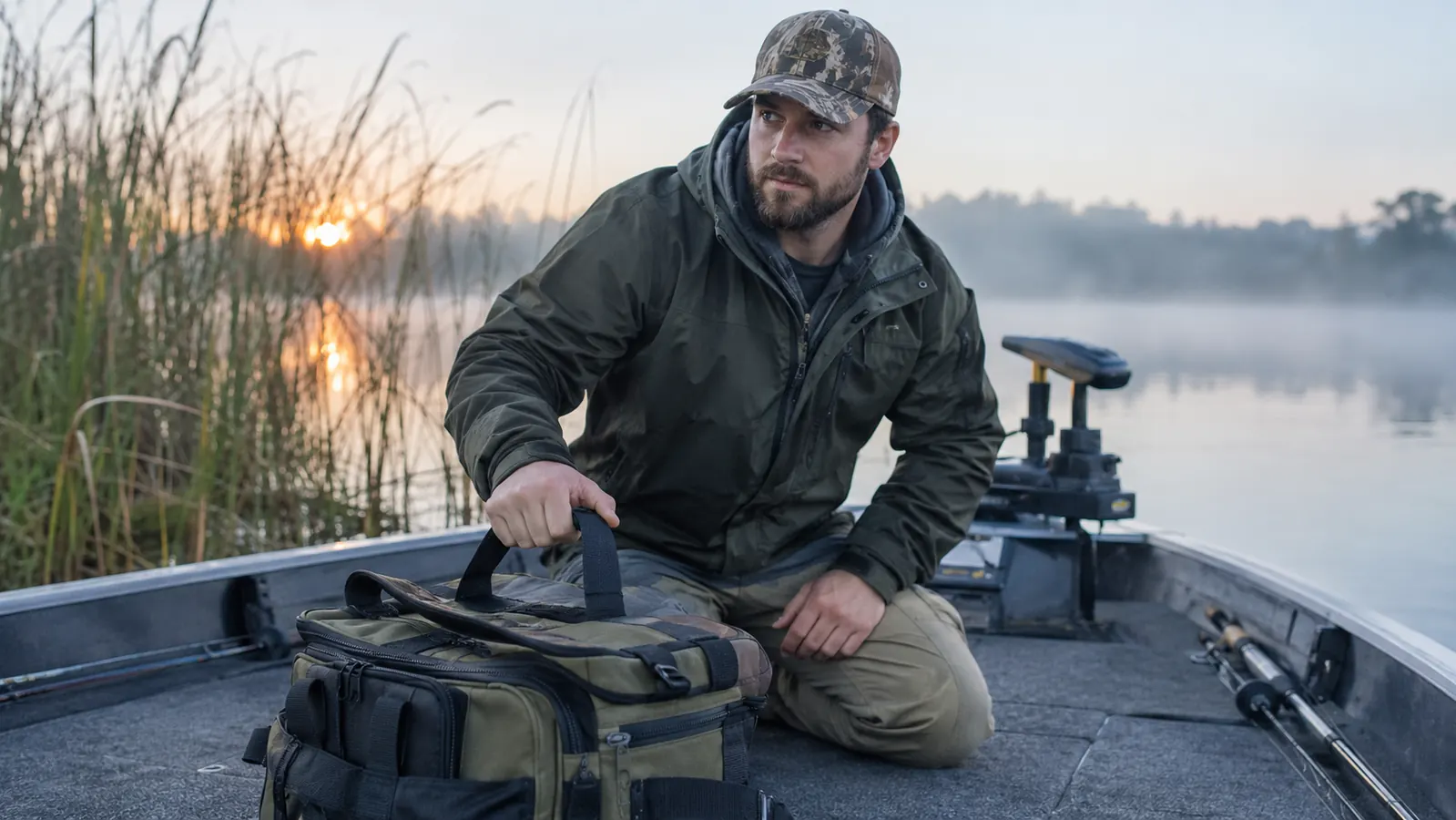
I bought the KastKing KarryAll in March because my old hard box had finally cracked a hinge and I was tired of listening to plastic rattle every time I hit a wake. What I wanted was simple. One bag that holds a working set of 3600 boxes, sits flat on the deck of my 17-foot aluminum boat, and does not fall apart by July.
Eleven months later it has been on Wilson and Pickwick maybe thirty trips, plus a dozen mornings on a farm pond where I fish from the bank. It has been rained on, stepped around, thrown in the truck bed, and sniffed thoroughly by Ruby, my black Lab mix, who is convinced there is a sandwich in there somewhere. Here is the honest version, including the parts I do not love.
The Quick Verdict
A genuinely tough soft bag that swallows six 3600 trays and shrugs off rain and gravel. Buy it if you want light and simple. Skip it if you carry more than six boxes or need everything locked and rigid.
Amazon Check Today's Price →Six boxes, one bag, no rattle on the deck
The KarryAll holds up to six 3600-size trays with room left for terminal tackle and tools. Water resistant 600D Oxford shell, shoulder strap, three zippered compartments.
Amazon Check Today's Price on Amazon →How I've Used It
I am 54, retired from line work, and I fish mostly weekday mornings now. My boat is nothing fancy, a 17-foot aluminum jon-style hull with a 40 hp outboard and a bow-mount trolling motor. Deck space is the whole argument. A hard box takes up a rectangle and refuses to move. A soft bag takes up the shape you stuff it into.
Before this I tried three other setups and all three annoyed me. A milk crate with two bungee cords is cheap and it works, but it holds rainwater and the boxes slide around inside it. A hard box in the 3700 size is a fine box, and mine lasted six years, but it is heavy before you put a single bait in it and it will not sit flat on a deck that is rocking. And a mesh wading bag carries two boxes and nothing else. Each of those was a compromise. The KarryAll was the first one that was not.
First trip out was March 14 on Wilson, water at 54 degrees and stained after two days of rain. I loaded five trays and a small box of hooks and weights. What I noticed before I ever made a cast was that the bag did not move. My hard box used to shift a half inch every time the trolling motor torqued. This thing sat exactly where I put it. I caught four fish that morning on a craw-colored crankbait out of the second tray, and I got that tray out and back in without standing up. That is the whole value of a soft bag, and it showed up on day one.
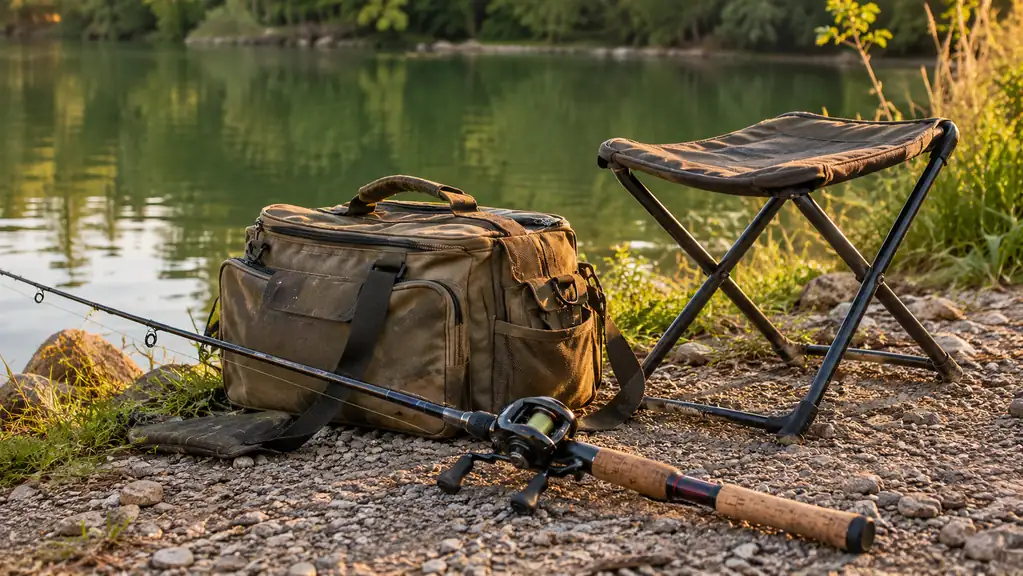
For eleven months the KarryAll has lived in one of two places. On the boat it rides just behind the front deck, where I can reach it without standing up. On pond days it goes over my shoulder on the strap and sits on the gravel bank next to my stool. Same bag, two completely different jobs, and it never felt like the wrong tool for either one.
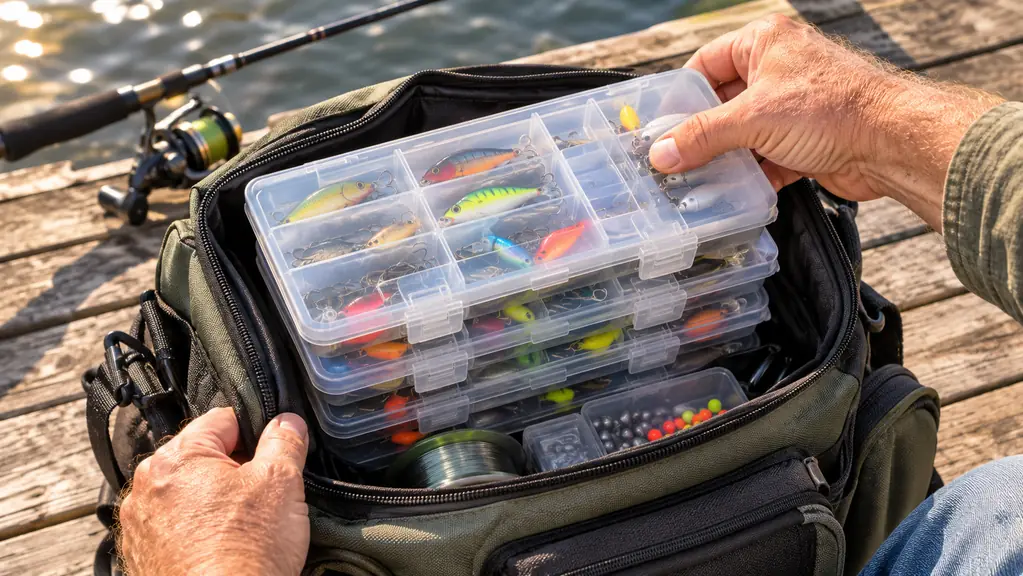
What I carried in it: five 3600-size trays in the main compartment, a sixth tray jammed in the upper zippered section when I wanted a dedicated crankbait box, a small box of hooks and weights in the utility pocket, pliers, line clippers, a spare spool of 12-pound fluorocarbon, sunscreen, and a sandwich. That is a full day for me. It zipped shut every time.
What the Shell Actually Survived
The material is 600D Oxford, and KastKing calls it tear and abrasion resistant and water resistant, not waterproof. That distinction matters and I want to be straight with you about it. This is not a dry bag. It is a bag that sheds a rain shower and a splash and keeps the trays inside from sitting in a puddle.
It got caught in a proper thunderstorm in June on Pickwick. I did not make it back to the ramp before it cut loose. The bag sat on the open deck for maybe twenty minutes of hard rain. When I got home and opened it, the top tray had a little water in the bottom of two compartments and everything below it was dry. The outside was soaked through. The inside was fine enough that I did not have to re-tie anything.
The abrasion part is where it really earned its keep. Gravel banks are murder on bags. So is the diamond plate on a boat trailer. After a season of getting dragged and dropped, the bottom of mine has a scuff on one corner and a little fuzz where the weave rubbed. No hole. No tear at the seam. I have had canvas bags go through in a season of that treatment.
Two specific beatings stand out. The first was the riprap at the Wilson dam tailrace in early May, where I slid the bag down about fifteen feet of chunk rock on its side because I was not going to carry a bag and a rod down that slope at the same time. The second is the truck bed. I do not run a bed liner, so the bag rides on bare ribbed steel next to a couple of rod socks and a landing net, and it slides around back there on every turn. Both of those are exactly the kind of dumb treatment that eats a bag alive. Mine has one scuffed corner from the riprap and nothing at all from the truck.
One more thing about the shell. It is soft, and soft means it conforms. Wedged between the console and the seat it stays put instead of sliding around every time the hull rocks. The web handle on top is the grab point I actually use, and it has not stretched or separated.
The Zippers and Compartments, Eleven Months In
Zippers are where cheap bags die. They either jump the track or the pull snaps off. The KarryAll has three zippered compartments and all three are still running smooth on mine.
The main compartment opens wide and lays back flat, which is the single most useful thing about the design. I can see all five trays at once and pull the one I want without unpacking the whole bag. When you are working a point and the wind is pushing you off it, being able to get a bait in fifteen seconds instead of two minutes is the difference between fishing and messing around.
I keep the trays in a fixed order so I can grab without looking. Top is topwater and squarebills, second is mid-depth crankbaits, third is jigs and trailers, fourth is the soft plastics I throw most, fifth is odds and ends. I wrote that order on a strip of tape on the inside of the lid for the first month, until my hands had it memorized. The lid lays back far enough that all five are visible at once, and it stays open in a ten mile an hour wind, which surprised me, because a soft lid usually wants to flop shut on your knuckles the second you let go of it.
The upper zippered section is smaller and that is where a sixth tray goes, or where I put things I want to get to fast. The utility pocket on the outside is where the pliers live. It is not a cavernous pocket. It fits a small box of hooks and weights and a tool or two, and that is what it is for.
Here is my one real gripe. There is no dedicated spot for a soft plastic bag or a bait binder that does not involve giving up a tray slot. I throw a gallon zipper bag of stickbaits in loose on top and it works, but it is loose. If you are a plastics guy who carries six bags of different colors, you are going to want to plan for that.
Twenty minutes of hard rain on an open deck, and two compartments in the top tray had a little water. Everything below was dry. Not waterproof. Water resistant, and it means it.
Living With It on the Water
Weight is a real factor when you are 54 with a bad shoulder. The bag itself is light. KastKing lists it at 0.85 kg, which is under two pounds, so the weight you carry is the weight of your tackle, not the bag. My old hard box was heavier empty than this thing is full of trays.
The shoulder strap is what makes bank days work. I load it, sling it, walk a quarter mile down the pond dam, and set it down. It rides reasonably flat against your side instead of swinging. It is not a padded backpack harness and it was never meant to be, so on a long walk with a full load you will feel it. For a quarter mile it is nothing.
The farm pond is the real test of that strap. There is a gate at the top of the dam and a quarter mile of gravel road down to the water, and I walk it with a rod in one hand and the bag on the other shoulder. Loaded with five trays, pliers, and a bottle of water, mine runs somewhere around twelve pounds. Twelve pounds on one shoulder for a quarter mile is nothing at all. Twelve pounds for half a mile would start talking to me, and on that trip I would want a different bag.
In the boat, the strap gets tucked and the bag sits. It measures 13 inches long, 11 wide, and 11 tall, so it fits behind the front deck of a 17-foot hull without crowding me. It also fits in the storage between the seats on the days I want the deck clear.
Ruby rides along on calm mornings and has to be kept away from treble hooks, which means the bag occasionally gets a wet nose across the lid. The 600D shell wipes clean with a damp rag. That sounds like a small thing until you have owned a bag that stains.
Where It Falls Short
Six 3600 boxes is the ceiling, and if you are a serious tournament angler that is not enough. I know guys who carry three times that. This is a bag for a working set of baits, not a rolling tackle store. If you need more, you need a bigger bag, and this is not it.
There are no wheels on it. That is fine by me, because wheels on a soft bag are a compromise anyway, but if you are hauling a long way from the truck to the water, you are carrying it.
I fish with a fellow who hauls a rolling box the size of a small cooler, and he has told me twice now that six boxes is not enough. He is right, for him. He fishes team tournaments and carries forty pounds of plastics and a spare graph. I fish Wednesday mornings and I want to be back in the truck in ninety seconds. Those are different jobs and they want different bags, and I would not try to talk him into mine.
And it is soft. A soft bag will not protect a graph or a camera or anything fragile. It is not a hard case and it should not be judged as one. It also will not keep a determined raccoon out, which I learned the hard way at the pond in August. I left it on the tailgate while I walked down to check the water level, came back, and the lid was open and a bag of craws was gone. Nothing broke. Nothing tore. The zipper was still fine. A hard box would have kept him out, and I know that, but I also know I would still be the one carrying the hard box.
What I Liked
- 600D Oxford shell took a full season of gravel banks and trailer diamond plate without a tear
- Holds up to six 3600-size trays with the main compartment opening flat for fast access
- Shed real rain on an open deck with only minor water in the top tray
- Under two pounds empty, so you carry tackle, not bag
- Shoulder strap makes quarter-mile bank walks easy
- Wipes clean and does not hold stains
Where It Falls Short
- Not waterproof, and KastKing does not claim it is
- Six trays is the ceiling, which is tight for tournament anglers
- No dedicated soft plastic storage outside the tray slots
- No wheels, so long carries are on your shoulder
- Soft shell offers no protection for fragile gear
Who This Is For
This bag is for the weekend and weekday angler who wants one simple, light, tough container for a working set of baits. If you fish a small boat or a kayak or from the bank, and you carry five or six 3600 boxes plus tools and terminal tackle, the KarryAll is sized exactly for you. It is also a good fit if you are tired of hard boxes rattling and sliding and want something that conforms to the deck.
It is a good second bag too. Plenty of guys keep the big rolling box in the garage and want something they can grab for a two-hour pond trip. This is that bag.
Who Should Skip It
Skip it if you carry more than six 3600 trays. Skip it if you need rigid protection for electronics. Skip it if you regularly make a half-mile walk to your spot and want wheels. And skip it if you fish in a way where everything gets soaked, because water resistant is not waterproof and KastKing is honest about that on the label.
If none of those describe you, this is the bag I would hand you at the ramp. It did everything I asked for eleven months and it is still the bag in my truck right now. That is the whole review.
The bag that is still in my truck after a full season
Water resistant 600D Oxford, three zippered compartments, room for six 3600 trays and your tools. Light enough to sling over your shoulder on the walk down the dam.
Amazon Check Today's Price on Amazon →