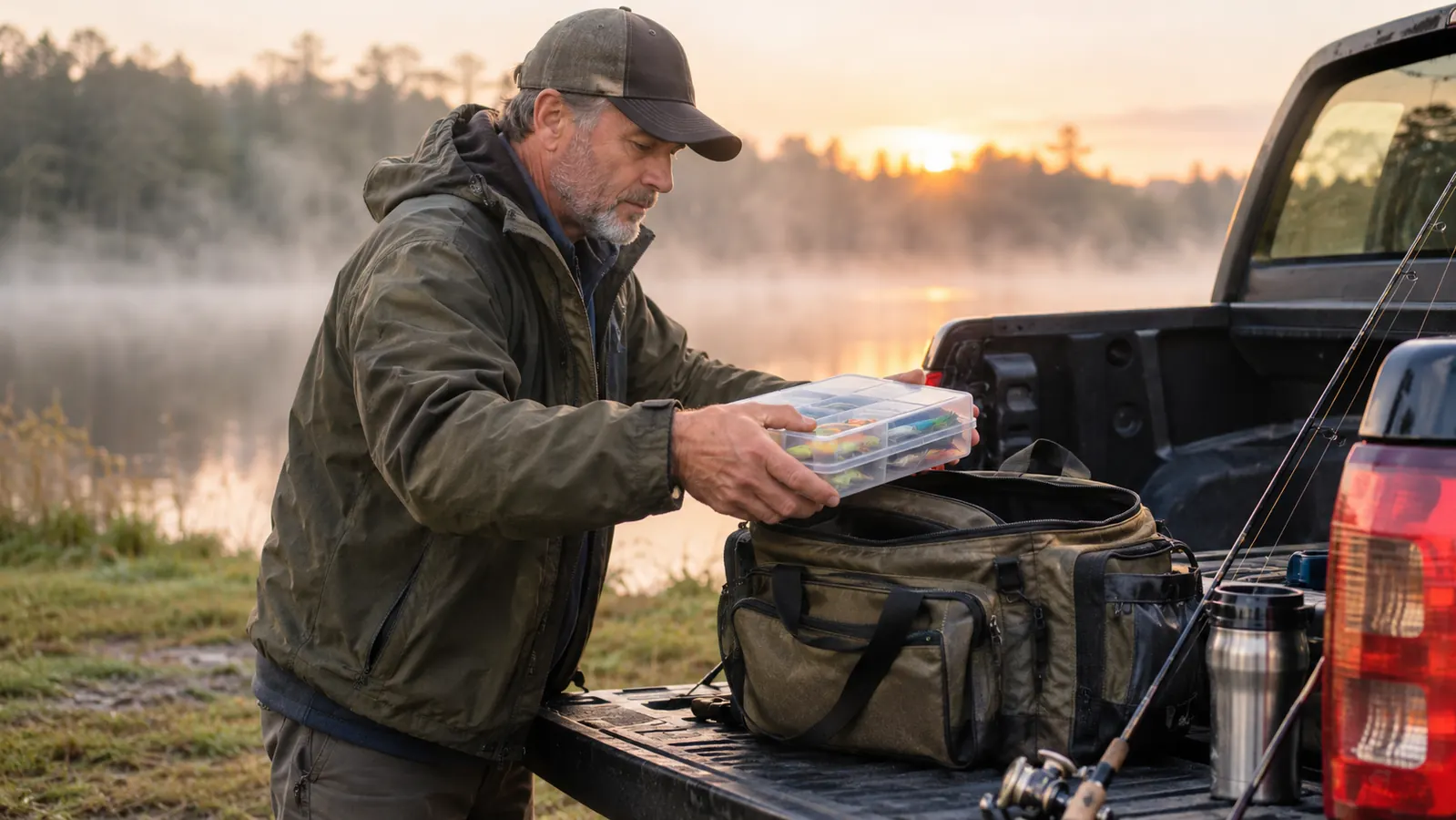
My tackle used to live in three places at once. A plastic box under the front deck of the jon boat, a canvas bag in the truck bed that had worn a permanent dip in the liner, and a coffee can of hooks on the workbench in the garage. Every Saturday started the same way, with me standing in the driveway at first light moving hooks from one container to another while the fog burned off Wilson and the bass finished their first feed.
That is not a storage problem. It is a time problem. The first hour of light is worth more than the next four combined, and I was spending it in my own driveway. What fixed it was not more boxes. It was the KastKing KarryAll and a system inside it that works the same whether I am standing on a farm pond bank or sitting on the front deck with the trolling motor down. Two seasons of asking smaller bags to do a job they were not built for is what got me there.
Six 3600 Boxes, One Bag, Either Kind of Water
The KarryAll measures 13 by 11 by 11 inches, weighs about 0.85 kg empty, and takes up to six 3600 size boxes. The same load walks a pond dam or steps onto the front deck.
Amazon Check Today's Price on Amazon →Five Steps to One Bag That Travels to the Water
Step 1: Empty the Whole Mess and Sort by Where You Fish
The first step costs nothing and takes one evening in the garage. Dump every hook, weight, crankbait, swimbait and worm onto a folding table and split it into three piles. The first pile is what you actually fished in the last twelve months. The second is what you fish from the bank. The third is everything else, and it is bigger than you think it is.
That third pile is the one that has been costing you. I had four packs of worm weights in four different containers, and two of them were the same size. Sort first, because a bigger bag does not solve a duplication problem. The KastKing KarryAll is 20 liters and gives you a 13 by 11 by 11 inch footprint, which is a lot of room in a bag that still fits behind the seat. Fill it with duplicates and you have simply built a heavier version of the mess you started with.
One more thing about the boxes themselves. If your 3600 trays came from three different makers, they are not all the same 3600. Some are deeper, the latches sit in different spots, and they stack badly against each other. Standardize on one tray and the main compartment turns into a drawer system instead of a puzzle. I spent a Saturday morning learning that, and it was time well spent.
Darlene walked through the garage about halfway through the sort, looked at the table, and asked if I was having a yard sale. Fair question. The third pile went into a clear tote in the attic, and I have been back into it twice in two years, both times for a color of jig I could not find anywhere else. That is the whole reason to keep it, and the whole reason it does not belong in the boat.
Step 2: Load the 3600 Boxes by Depth Zone, Not by Color
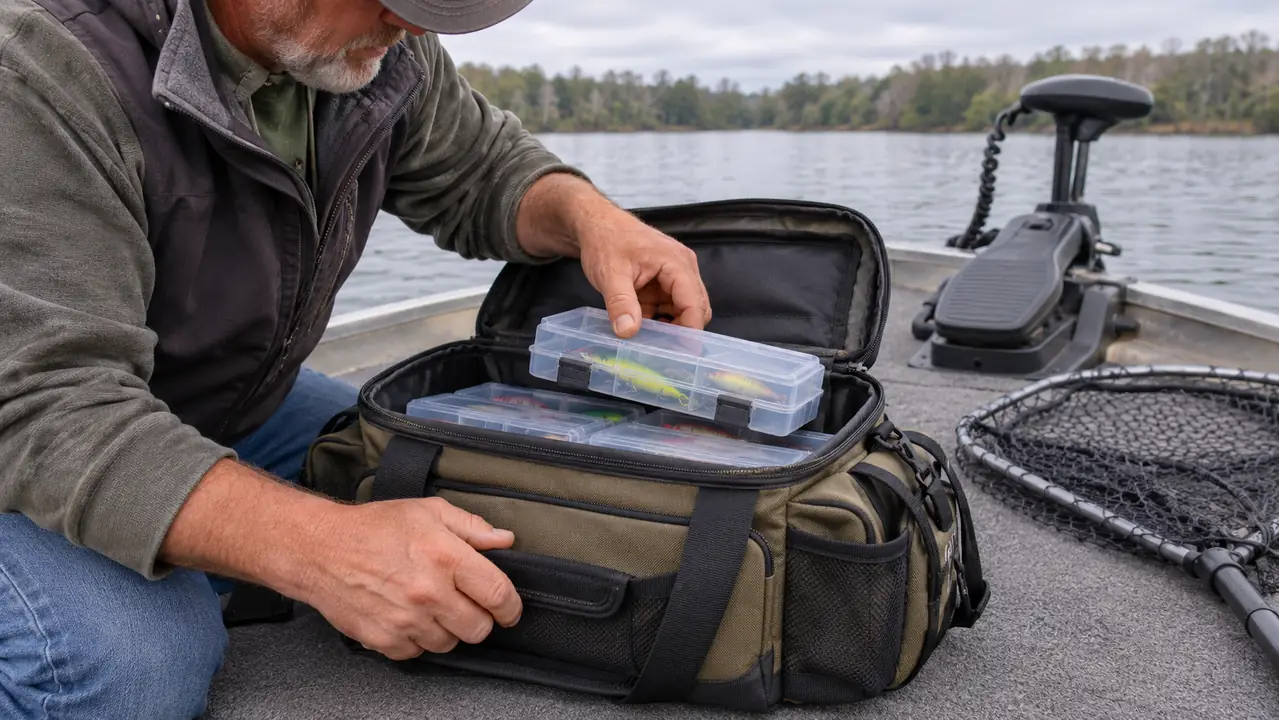
Color sorting is what everybody does and it is the reason you dig for two minutes while your partner is already casting. I run five 3600 boxes in the main part of the bag, set vertically, one box each for shallow, mid depth, deep, soft plastics, and a junk box for the beat up baits I still throw.
Vertical is what works for me on the water. You pull one box out, look down at the tops of the baits, and slide it back. The listing puts the bag at up to six 3600 boxes when you pack terminal tackle and tools alongside them, so there is room to add a sixth if you keep your tools somewhere else. I have run it both ways and five plus tools is the load that stays organized past July.
The junk box earns its place. Twice this spring I broke off a squarebill on the riprap below Wilson Dam, and the only bait the fish wanted that morning was the same model with the paint chewed off. That bait lives in the junk box, on top, in the first slot I can reach without looking. Sort by what the fish are doing, not by what the package looks like.
Six 3600 boxes, one shoulder strap, and a 13 by 11 by 11 inch footprint. That is the whole system, and it fits behind the seat of a 17 foot jon boat.
Step 3: Give Terminal Tackle Its Own Zippered Pocket
Terminal tackle is where a bag either works or it does not. Hooks, weights, swivels, beads, bobber stops and a hook sharpener will find each other and tangle if you let them. The KarryAll has three zippered compartments plus a utility pocket, and I claimed one zippered compartment for terminal tackle on day one and have not moved it since.
One compartment, one rule: everything inside it lives in a small box or a zip bag, nothing loose. Loose hooks are how you spend ten minutes picking 2/0 wide gaps out of a towel. They are also how you end up with a hook in a knuckle when you are reaching for something else in low light.
The utility pocket and the other two zippered sections take the rest. Pliers, line clippers, a spare spool of leader material, sunscreen, and the truck keys so I stop patting my pockets at the ramp. Every one of those has a home now, and the test is simple. If I have to think about where something is for more than a second, it needs a better home.
Step 4: Pack a Bank Load and a Boat Load From the Same Bag
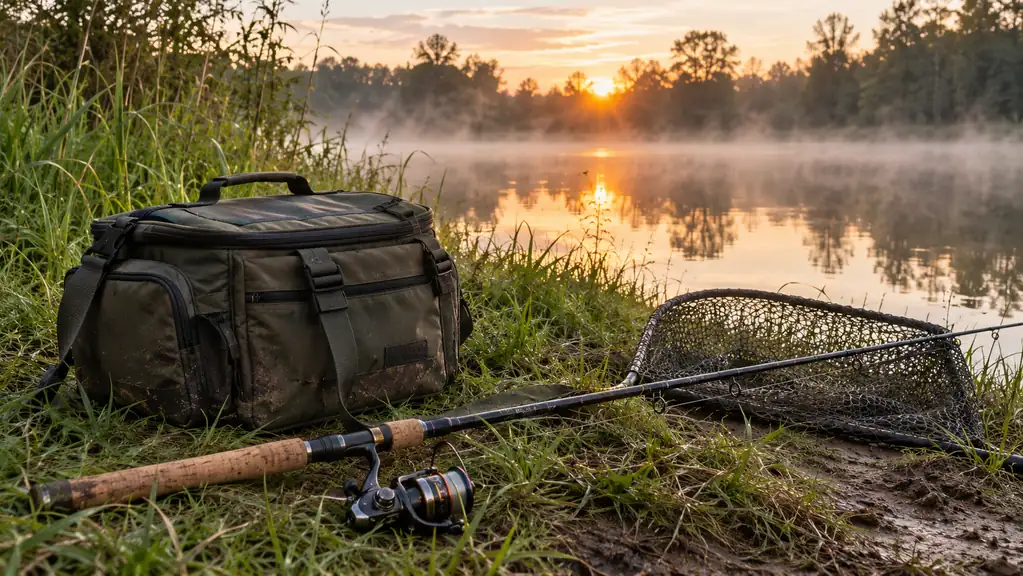
The bag covers both kinds of fishing, but it does not carry the same load. For a boat day I fill all five boxes and add the deep cranks, because the boat can run to the ledge and I might need them. For a bank day at the farm pond I pull the deep box and the deep cranks stay home. The pond is nine feet at the deepest hole. Carrying three pounds of baits for water that does not exist is how a light bag turns into a chore.
The bank load is where most people overpack, myself included. A pond bank outside Florence is not Pickwick. You are casting to cover you can see, the fish are usually shallow, and you can walk back to the truck in four minutes if you truly need something. Pack for the water in front of you and leave the rest in the truck.
The carry setup matters more than people give it credit for. The bag has a shoulder strap and a web handle, and the handle is what I use getting in and out of the boat, because a strap on one shoulder throws your balance when you are stepping over a gunwale. There are no wheels on this bag, and I want to be straight about that. It is a bag you carry. If you want to roll something down a long dock, this is not that bag and no amount of wishing will change it.
I also keep a small flat box in the truck with eight or ten baits that work in a pond, so the swap takes thirty seconds instead of ten minutes. Pull the boat boxes, drop in the pond box, and the KastKing KarryAll goes from a full boat load to a bank load without a second bag in the mix.
Step 5: Keep It Dry, Keep It Light, and Reset It Every Sunday
The shell is 600D oxford and it is water resistant, which is not the same as waterproof. Rain on the front deck beads up and runs off. A wave over the bow that soaks the bag for ten minutes is a different event entirely. I keep my phone, my keys and my license in a zip bag inside one of the zippered compartments, and I have never once regretted the two minutes it took to set that up.
Keep the load light. The bag weighs about 0.85 kg empty, so 20 liters of lead and hard baits gets heavy in a hurry on a long walk. Once a month I dump all five boxes on the tailgate and pull anything I have not tied on. This is not a storage unit. It is what you carry to the water, and everything inside it should have a reason to be there.
The Sunday evening reset takes five minutes. Check the zippers for grit, wipe out the terminal tackle compartment where mud and pond water collect, and lay the boxes flat so the hooks are not pressing into the plastic on the drive home. Ruby rides with me on calm mornings and has learned that an open box means stay back, but I still zip the bag before she climbs aboard. Treble hooks and a sixty pound Lab mix are not a combination I care to test.
What Else Helps
Two things outside the bag do most of the work. First, pre-tied leaders. I tie four or five at home in different lengths and keep them on a line spool in the utility pocket, so a break off costs me thirty seconds instead of three minutes in the dark. Second, a hook sharpener in that same compartment. A sharp hook turns a short strike into a landed fish, and it is the smallest piece of gear in the bag doing the most work.
Also worth doing: put a strip of tape on the lid of each 3600 box and write the depth zone on it. You will learn the layout in a week, but a guest in your boat will not, and neither will you at the end of a long day when your hands are cold and the light is gone. Labels cost nothing and they save the same two minutes every single trip.
None of this is complicated and none of it requires a bigger boat or another trip to the tackle shop. It requires one bag, five boxes, a home for every small item, and the discipline to leave that third pile in the attic where it belongs.
Build the System Once and Fish the Whole First Hour
20 liters, three zippered compartments, a shoulder strap and a web handle, sized to carry six 3600 boxes from the pond dam to the front deck. Check today's price on Amazon.
Amazon Check Today's Price on Amazon →