
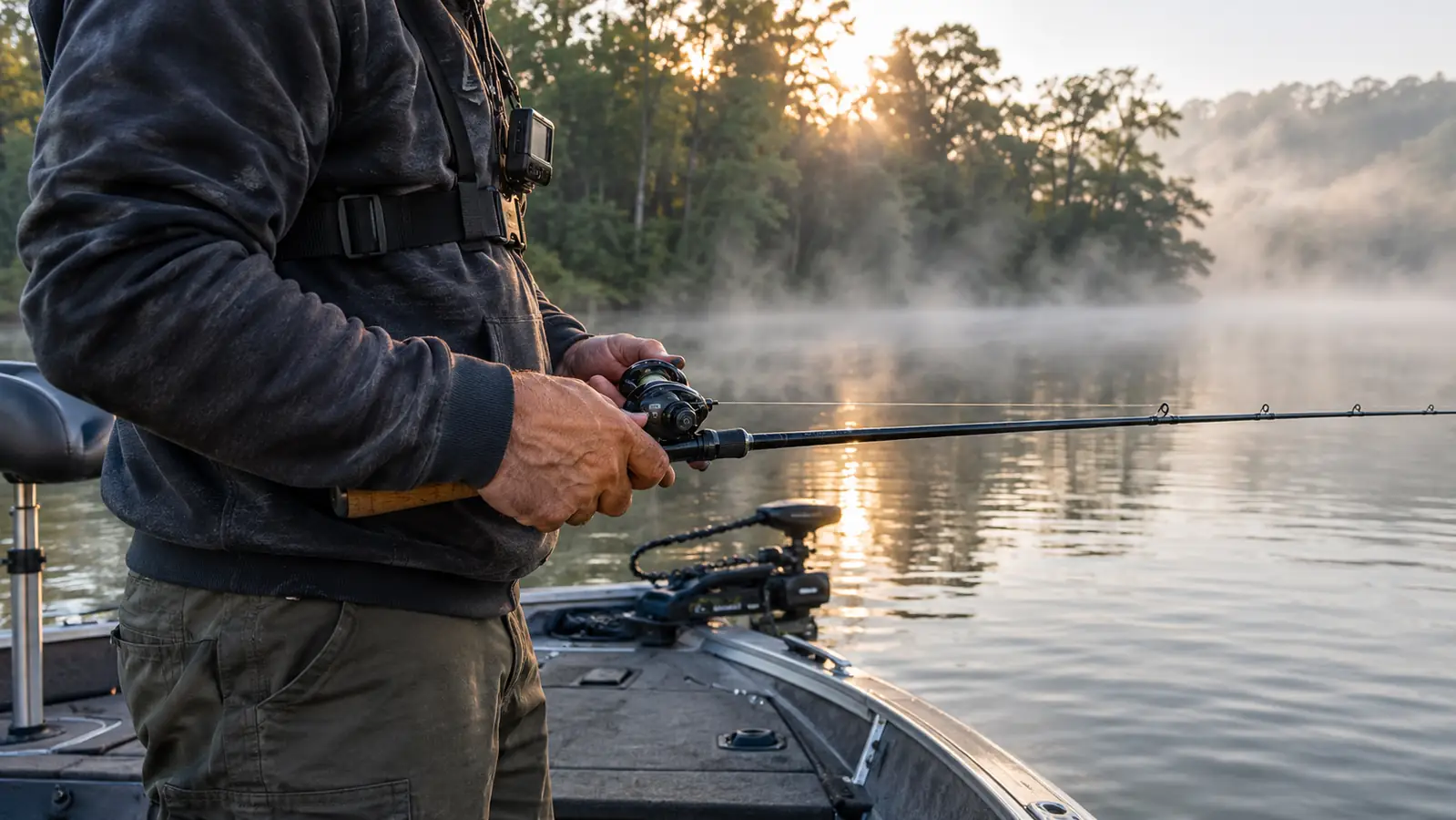
The first backlash I ever got cost me about forty yards of monofilament and most of my patience. I was fourteen, standing on a dock on Pickwick, and I had just tried to bomb a spinnerbait into a treeline with a thumb that never touched the spool. Forty years later I still flinch at that sound. The reel screaming, then the dead stop, then the tangle. It is the reason most people try a baitcaster once and go back to a spinning rod for good.
Here is what nobody told me back then. A baitcaster is not hard. It is just unforgiving of your first three casts. Get those right and the reel does the rest of the work for you. The KastKing Centron Lite combo is about the cheapest honest way into that learning curve I have found, and I have watched grown men quit on reels that cost three times as much. Seven foot medium heavy rod, IM6 graphite blank, split rear handle, and a 7.1:1 reel rated for 15.4 pound monofilament. That is a real bass setup. It is not a toy, and it is not a rod you throw in the shed after a month.
The cheapest honest way into a baitcaster
Seven foot medium heavy IM6 graphite blank, 7.1:1 reel, rated for 15.4 pound mono. Spool it, set the tension, and learn on a combo you will still be fishing in three years.
Amazon Check Today's Price on Amazon →Step 1: Spool It Right and Leave Room on the Rim
Load it with monofilament first. The reel is rated for 15.4 pound line and that is a fine place to start, not a limit you need to push. Mono is cheap, it comes off the spool in a way you can see and feel with your thumb, and when you do birdnest it you are out a few dollars instead of a spool of braid you were saving for a tournament that never happens. Braid is not a beginner line. It has no stretch, no memory, and no forgiveness.
I learned that one the hard way. The first reel I ever spooled up myself got a spool of braid because a fella at the tackle counter told me it was what the tournament boys ran. Two casts into the morning I had a tangle so tight I had to cut it off at the spool, and I lost thirty yards of line that cost more than a whole filler spool of mono would have. Mono first. Always. Get your thumb trained on something that costs almost nothing to replace, then move up once you can go a session without picking.
Fill it to about an eighth of an inch below the rim. Not to the lip. An overfilled spool is the single most common reason a new baitcaster angler backlashes on a cast that felt perfectly fine. The line has nowhere to go but off the front, all at once, and your thumb cannot catch what has already left.
Run the filler spool on a pencil through the middle. Hold the rod so the line comes off the top of the filler spool and pinch the line between your thumb and forefinger while you crank. You want tension, not a death grip. When you are done, the line should feel tight and even across the spool, not spongy. If you can push a thumb into it and leave a dent, it is too loose, and loose line is what comes off in a wad on your first hard cast.
Step 2: Set the Spool Tension Before You Make a Cast
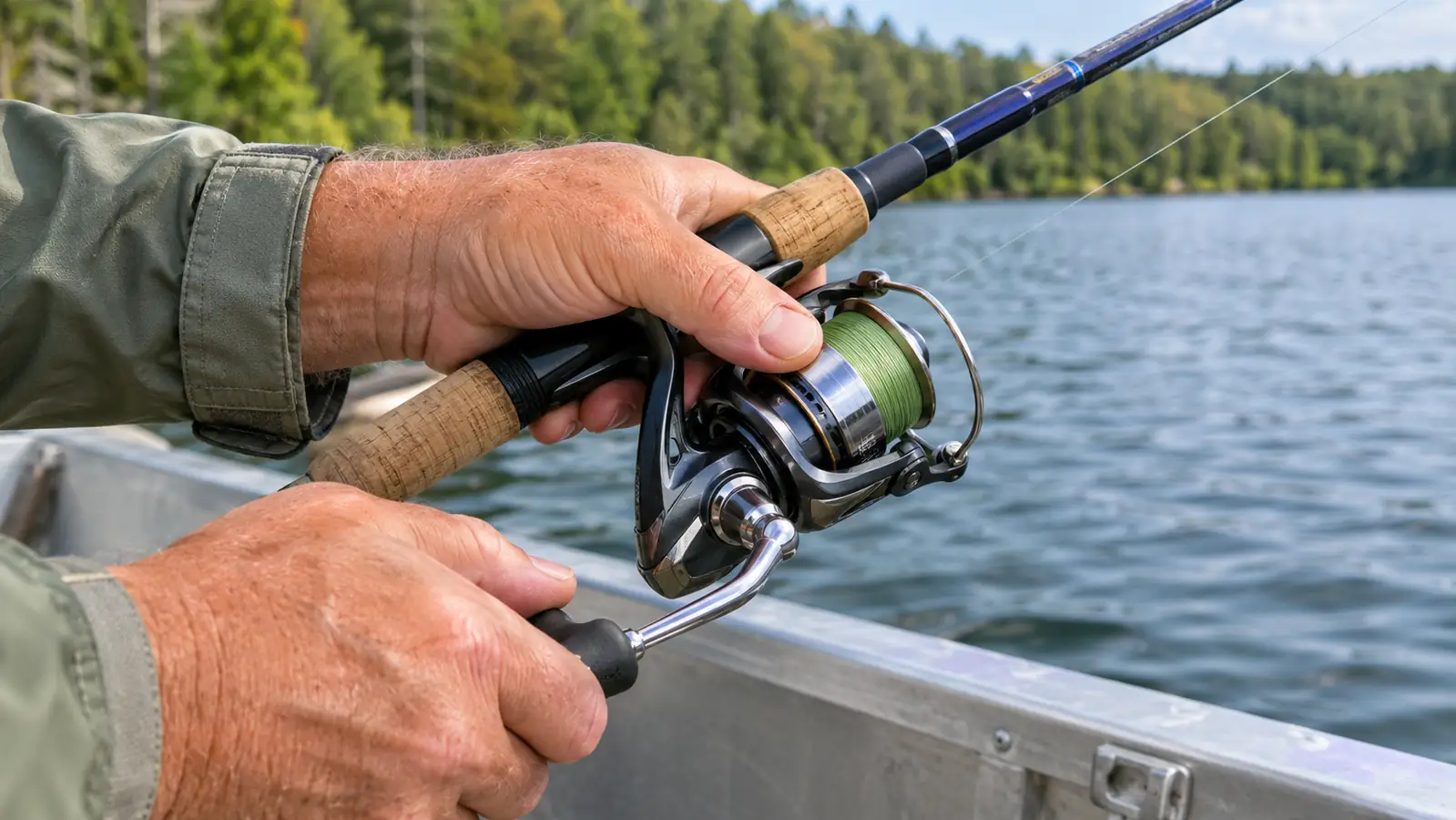
Tie on a practice plug or a three eighths ounce jig and hold the rod out at about 45 degrees. Push the thumb bar, let the bait fall, and watch it. It should drop slowly and stop the instant it touches the ground, without the spool spinning on and spitting line off the front.
If the spool keeps turning after the bait lands, you have too little tension. Turn it in and try again. If the bait barely falls, or the rod tip dips when you release the thumb bar, it is too tight and you will come up short on every cast all day and blame the rod. Every baitcaster I have ever owned works the same way, with a spool tension knob on the side plate, and this is the setting most people never touch after the first morning. That is a mistake. It is the one adjustment that keeps a beginner out of trouble.
Start with more brake than you think you need, and turn it down one click each practice session as your thumb gets better. Nobody learns to cast by starting on the loose setting. That is how you spend a Saturday on the bank with a pocketknife and a bad attitude, and I have been that man more than once.
I keep a three eighths ounce lead practice plug in the console of the boat for exactly this. Same weight as the jig I throw most of the year, so the setting I dial in over the driveway is the setting that works over water. Come back to it every spring, too. A reel that sat in the shed since October has a dry spool and a tension knob that has crept a little, and ten minutes of re-setting it saves you the whole first hour of your first trip out.
Step 3: Learn the Sidearm Lob Before the Overhead Bomb
The overhead bomb is the cast you see in the videos and it is the last one you should learn. It puts the whole spool in play at once, from the highest point of the rod arc, and a beginner's thumb is not ready for that. Start instead with a sidearm lob. Rod back to your side, elbow loose, and push the rod forward smooth, letting the bait load the tip instead of whipping it.
The word for the day is smooth. Not fast. A baitcaster punishes a hard start and a sudden stop far more than it punishes a slow, even cast. When you try to muscle it, the tip snaps over and the spool keeps spinning long after the bait has already left. That is your backlash, and it happens before you feel anything go wrong.
Ten yards is a fine cast for the first hour. Twenty is fine for the first week. The distance comes from the rod loading, not from your shoulder, and you cannot feel the rod load if you are trying to throw the bait into the next county.
Wind will undo a smooth cast faster than anything else. I fished Wilson one March morning with a south wind running about fifteen, and every cast into it came up short while every cast with it came back with a loop in the spool. The fix was not more muscle. It was casting lower and flatter, keeping the rod tip down and letting the bait travel instead of arcing up into the gust. A sidearm lob into the wind at ten yards beats a bomb that tangles at fifteen, every single time.
Seven feet of medium heavy graphite and a 7.1:1 reel rated for 15.4 pound line is the same setup I fish with. It is not a beginner rod. It is a rod you can still fish after you stop being a beginner.
Step 4: Keep Your Thumb on the Spool the Whole Way
Your thumb is the brake that matters. Rest it on the spool, not on the frame, and leave it there from the moment you push the thumb bar until the bait hits the water. Light pressure. Not a clamp, not a hover. Contact.
Feather it as the bait comes down. Raise the pressure a little so the spool slows with the bait instead of running ahead of it. Then stop the spool the instant the bait touches down. Do that on every cast and the reel never gets a chance to overrun, because the spool never gets to spin free for more than a heartbeat.
This is the part you practice in the yard, with a practice plug and no water in sight. Fifty casts on grass is worth more than a hundred on the lake. You can see where the bait lands, you are not distracted by a bass blowing up two feet off the bow, and nobody is watching you learn.
I use the side yard behind the garage and a five gallon bucket lid laid out at about thirty feet. Fifty casts at a lid teaches you two things at once: where your thumb has to be and where the bait is actually going. It took me three evenings before I could put eight of ten inside that circle, and that was with a thumb carrying forty years of spinning rod habits it had to unlearn. Do not skip the evenings because the water looks better than the yard does.
Step 5: Pick Out a Backlash Without Cutting Your Line
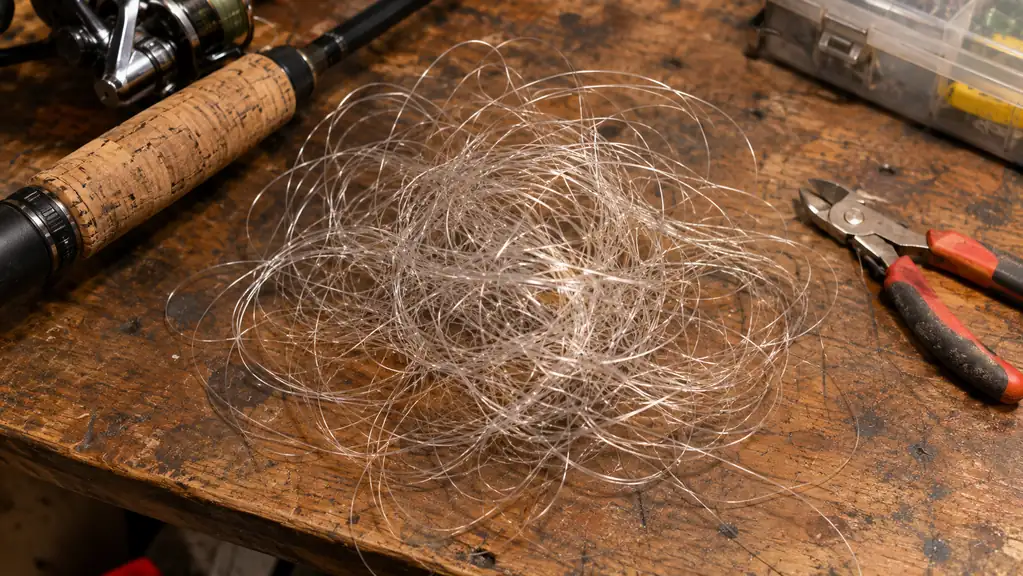
Sooner or later you will get one. Probably on a cast into the wind with a light bait, or on the one cast where you got careless because the first twenty went fine. Do not cut it out. Nine out of ten backlashes come apart if you are patient, and the tenth one is usually not as bad as it looks from the boat seat.
Press your thumb on the spool so it cannot turn. Pull the line straight off the front with your other hand and hold it there. Then turn the spool backwards with your thumb while you keep pulling. The loop usually lifts right out. If it does not, back the spool tension off a quarter turn and try again. Digging at it with a hook point is how you scratch a spool and turn a five minute job into a full respool on the tailgate.
If it is worse than that, and you will know it when you see it, strip the line back to where it lies flat and crank it on under tension. A backlash left buried in the spool will come back out on the next cast, and the one after that, and you will spend the whole morning chasing the same tangle instead of fishing.
What Else Helps
The rod does a lot of the work here, and the KastKing Centron Lite is set up better than the price would suggest. Seven feet of medium heavy IM6 graphite is enough backbone to drive a hook through a Texas rig and enough tip to load on a short lob cast. The split rear handle puts your hand where it belongs for casting instead of making you choke up on a full grip. The EVA foam grips stay put in a wet hand, which matters more in November than it does in May.
The two piece breakdown is the detail I use most. A seven foot rod does not ride in the cab of a truck in one piece without moving the seat, and mine lives broken down behind the seat of the boat most of the season. The 7.1:1 gear ratio is quick enough to pick up slack on a jig before a bass shakes it loose, and slow enough that you are not cranking a squarebill like a man trying to start a lawnmower in February. The drag is rated at 15.4 pounds, which is more than you will ever use on a Tennessee River bass.
The size shown is the 7 foot medium heavy in right hand retrieve, and that is the one I would tell a beginner to order. Read the size line before you check out, because the same combo comes in other lengths and the reel handle side matters. Nothing on this rig needs upgrading before you learn on it. Spool it, set it, and fish it. Upgrade the line when you can go a whole session without picking at the spool, not before.
If you are going to learn, learn on this one
KastKing built the Centron Lite for the angler who is tired of a spinning rod on a windy bank. Seven foot medium heavy, 2 piece, 7.1:1 reel. Check today's price before your next Saturday on the water.
Amazon See the KastKing Centron Lite on Amazon →